
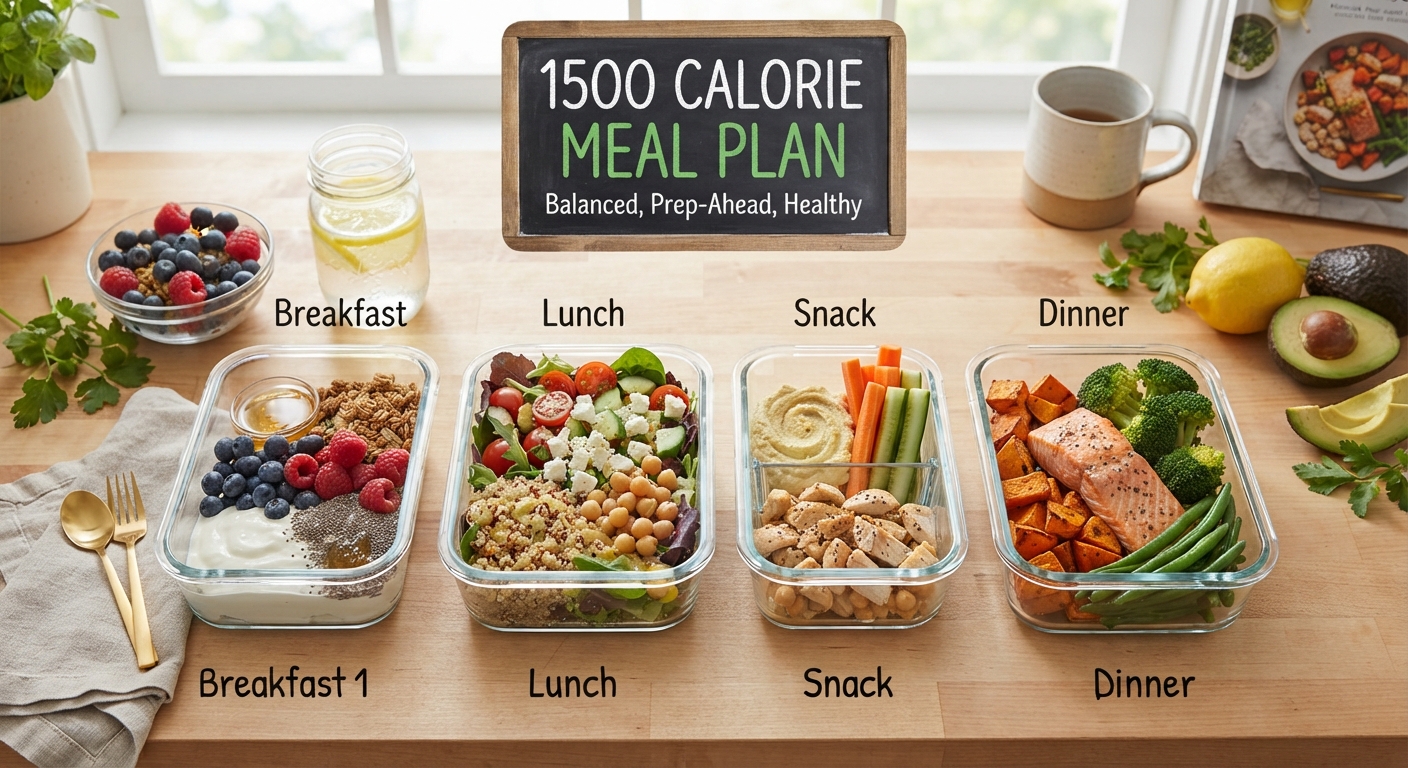
1500 calories is the most broadly useful weight-loss target there is — high enough that most people can actually live on it, low enough to produce real loss for the majority of adults. It’s also the level most often picked by guesswork. This plan gives you seven days with itemized numbers, and starts by checking whether 1500 is the right target for your body rather than assuming it.
Table of Contents
Is 1500 Calories Right for You?
Published clinical guidance describes conventional weight-loss diets as cutting 500–750 calories from maintenance, landing at 1200–1500 kcal/day for women and 1500–1800 kcal/day for men. 1500 sits at the top of the women’s range and the bottom of the men’s — which is exactly why it fits so many people and why it’s worth verifying rather than assuming.
Worked example. A 35-year-old woman, 5’6″, 170 lbs (77 kg), light activity (one or two workouts a week):
- BMR: (10 × 77) + (6.25 × 167.6) − (5 × 35) − 161 = 1,481 calories
- TDEE: 1,481 × 1.375 (light activity) = 2,037 calories
- 500-calorie deficit: 2,037 − 500 = 1,537 calories
For her, 1500 is close to textbook — about a pound a week without an unsustainable cut. But change one variable and the answer moves. Make her sedentary and her TDEE drops to 1,777, making 1500 a gentler 280-calorie deficit. Make her moderately active and TDEE climbs past 2,290, where 1500 becomes a nearly 800-calorie cut — too aggressive to hold.
Check yours before you shop. The Daily Diet Calculator runs Mifflin-St Jeor against your own stats and returns a goal-adjusted target. If it lands lower, the 1200-calorie plan covers that range; higher, and the 1800-calorie plan is the better fit.
What a 1500-Calorie Day Looks Like
| Meal | Food | Calories | Protein |
|---|---|---|---|
| Breakfast | Nonfat Greek yogurt, 1 cup | 130 | 22 g |
| Blueberries, ½ cup | 40 | 0 g | |
| Chia seeds, 1 tbsp | 60 | 2 g | |
| Whole-grain toast, 1 slice | 80 | 4 g | |
| Egg, 1 large | 70 | 6 g | |
| Lunch | Grilled chicken breast, 4 oz | 185 | 35 g |
| Mixed greens, 2 cups | 20 | 2 g | |
| Chickpeas, ½ cup | 120 | 6 g | |
| Avocado, ½ medium | 120 | 2 g | |
| Olive oil + vinegar, 1 tsp | 40 | 0 g | |
| Snack | Medium apple | 95 | 0 g |
| String cheese, 1 | 80 | 7 g | |
| Dinner | Baked cod, 4 oz | 110 | 24 g |
| Roasted broccoli, 1½ cups | 80 | 5 g | |
| Cooked quinoa, ¾ cup | 165 | 6 g | |
| Olive oil, ¼ tbsp | 30 | 0 g | |
| Evening | Low-fat cottage cheese, ½ cup | 90 | 12 g |
| Daily total | ~1,515 | ~133 g | |
That’s about 35% of calories from protein. The extra 300 calories over a 1200-calorie day mostly buy you things that make the diet survivable — a proper breakfast, avocado, a real portion of grain at dinner.
The 7-Day 1500-Calorie Meal Plan
| Day | Breakfast | Lunch | Dinner | Snacks | Approx. |
|---|---|---|---|---|---|
| Mon | Greek yogurt bowl + egg & toast | Chicken, chickpea & avocado salad | Baked cod, broccoli, quinoa | Apple + string cheese; cottage cheese | 1,515 / 133 g |
| Tue | 3-egg veggie scramble, 1 slice rye | Leftover cod, greens, sweet potato | Turkey chili with black beans | Pear; Greek yogurt | 1,490 / 126 g |
| Wed | Protein oats (½ cup oats, whey, berries) | Leftover turkey chili + side salad | Chicken thigh, roasted veg, ¾ cup rice | Carrots + hummus; almonds | 1,525 / 122 g |
| Thu | Greek yogurt bowl + egg & toast | Tuna, greens, avocado, rye crackers | Tofu & vegetable stir-fry, brown rice | Orange; cottage cheese | 1,480 / 120 g |
| Fri | 3-egg scramble, 1 slice rye | Chicken & chickpea salad | Baked salmon, asparagus, quinoa | Apple + string cheese | 1,535 / 128 g |
| Sat | Protein oats | Leftover salmon, big green salad | Lean beef mince, zucchini, potato | Berries + Greek yogurt; almonds | 1,510 / 130 g |
| Sun | Cottage cheese, tomato, 2 rye toast | Lentil soup + 2 boiled eggs | Roast chicken, veg medley, sweet potato | Pear; string cheese | 1,495 / 124 g |
Hitting Protein at 1500 Calories
Updated federal guidance now sets adult protein needs around 1.2–1.6 g per kilogram of body weight, up sharply from the old 0.8 g/kg figure — the shift we broke down in our piece on the new MAHA dietary guidelines. At 77 kg that’s 92–123 grams. This plan clears it comfortably, which matters more in a deficit than at maintenance.
The practical rule: anchor every meal with 25–35 g of protein before you add anything else, then fill the remaining calories with vegetables, whole grains, and fats. Build from our high-protein, low-calorie foods list and pair the plan with resistance work twice a week — our at-home strength training guide covers a no-equipment version.
Where the Flexible 300 Calories Go
The genuine advantage of 1500 over 1200 is that roughly 300 calories are discretionary. Spend them on whichever of these keeps you consistent:
- A real breakfast — eggs and toast instead of yogurt alone, if mornings are when you get hungriest
- A pre-workout snack — 30 g carbohydrate about an hour before training
- Eating out once a week — bank the calories across two days and keep the social meal
- More fat — avocado, olive oil, nuts. Better satiety per calorie than most carbohydrates
Our guide to low-calorie snacks covers the ratios that actually hold hunger; if your week is chaotic, eating healthy on a busy schedule is the companion piece.
Adjusting as You Go
Your TDEE falls as you lose weight, so a 1500-calorie target that produced a pound a week at 170 lbs won’t do the same at 150 lbs. Recalculate every 5–10 lbs of change and after any shift in activity. When you reach maintenance, step up rather than staying in a deficit indefinitely — the 1800-calorie plan and 2000-calorie plan are the next rungs. Our calorie deficit guide explains the timing.
Get Your Own Number
Enter your stats into the Daily Diet Calculator for your BMR, TDEE, goal-adjusted target, and macro split — then use whichever plan in this series matches. To see the arithmetic step by step, start with the TDEE calculator, and log meals against your target with the food calorie calculator.
Frequently Asked Questions
Is 1500 calories a day enough to lose weight?
For most adults, yes — but only if it’s below your maintenance level. Someone with a TDEE of 2,000 loses roughly a pound a week at 1500 calories; someone with a TDEE of 1,600 barely loses at all. The number only means something relative to your own maintenance figure.
Is 1500 calories enough for a man?
It’s the bottom of the standard clinical range for men (1500–1800 kcal/day), so it’s viable for shorter or sedentary men, or as a short-term aggressive phase. Most active men do better at 1800, which is easier to sustain and protects muscle more reliably.
How much protein should I eat on a 1500-calorie diet?
Target 1.2–1.6 grams per kilogram of body weight — roughly 100–135 grams for most people on this plan. Spread it across meals at 25–35 grams each rather than concentrating it at dinner.
How much weight can I lose in a month on 1500 calories?
If 1500 puts you in a 500-calorie daily deficit, expect roughly 4 pounds a month, since a pound of fat is about 3,500 calories. Early weeks often show more because of water-weight shifts, which isn’t fat loss and will level off.
What’s the difference between a 1200 and 1500 calorie meal plan?
Mainly sustainability and protein headroom. A 1200-calorie plan sits at the clinical floor and leaves almost no flexibility; 1500 allows a fuller breakfast, more fat for satiety, and room for an occasional meal out — which is why adherence tends to be considerably better.
This meal plan is general nutrition information, not medical advice, and isn’t a substitute for guidance from a doctor or registered dietitian — particularly if you’re managing a health condition, are pregnant or breastfeeding, or have any history of disordered eating.