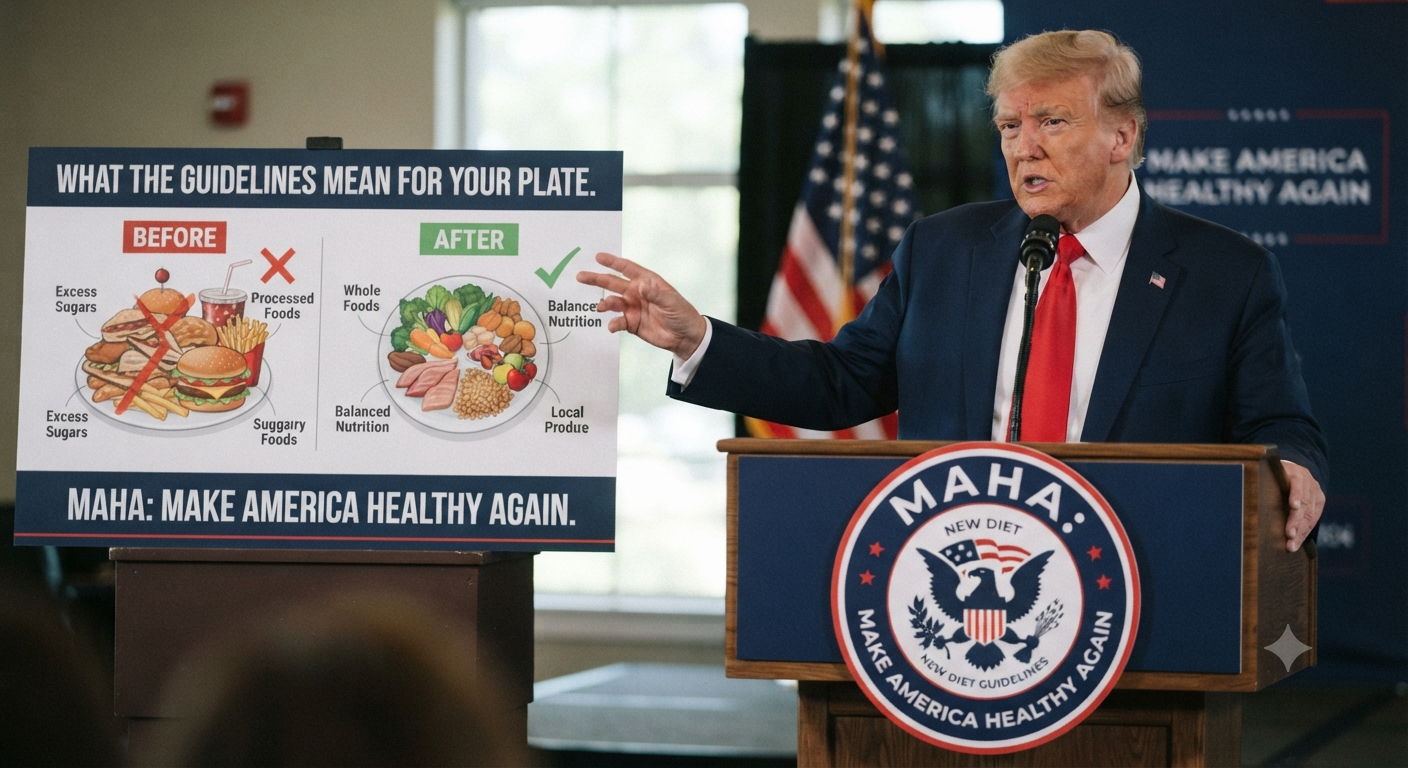
For most of 2025, “Make America Healthy Again” was a policy headline — commission reports, congressional testimony, a 78-page assessment on childhood chronic disease. Then, in January 2026, it stopped being abstract. The federal government released the Dietary Guidelines for Americans, 2025–2030, and with them, the first new USDA food pyramid since 2011. If you’ve seen the inverted pyramid graphic floating around and wondered what it actually changes about how much you should eat, this is that breakdown — with real numbers, not just talking points.
Table of Contents
What MAHA Actually Changed (Beyond the Rhetoric)
The Make America Healthy Again Commission, established by executive order in February 2025 and chaired by HHS Secretary Robert F. Kennedy Jr., built its case around five drivers of childhood chronic disease: poor diet, chemical exposure, inactivity, chronic stress, and overmedicalization. By September 2025, that assessment turned into a strategy report with roughly 120 policy initiatives spanning food procurement, school meals, and chemical regulation.
The part that reaches your kitchen directly is the updated Dietary Guidelines, published under the “eat real food” banner at RealFood.gov. Three concrete shifts came out of it:
- A new (old) food pyramid. MyPlate is gone. A pyramid is back, but flipped — protein, dairy, and healthy fats now occupy the widest sections, with whole grains shrunk to a smaller base tier.
- Protein targets roughly doubled. The longstanding RDA of 0.8 g per kilogram of body weight is gone in practice, replaced with a range of 1.2–1.6 g/kg.
- Full-fat dairy is back in favor, with guidance for three daily servings, reversing decades of low-fat/fat-free recommendations.
On the regulatory side, the FDA’s 2026 priority list includes closing the GRAS (“Generally Recognized as Safe”) loophole that currently lets companies introduce food additives without notifying the agency, plus post-market safety reviews of chemicals already in the food supply. The USDA has paired this with procurement changes to schools, SNAP, and military dining — redirecting food-program dollars toward less processed options.
The New Food Pyramid, in Actual Servings
Here’s what changed between the 2020–2025 guidance and the 2025–2030 version, side by side:
| Category | Previous Guidance | 2025–2030 Guidance |
|---|---|---|
| Protein (RDA) | ~0.8 g per kg body weight | 1.2–1.6 g per kg body weight |
| Dairy | Low-fat or fat-free preferred | 3 servings/day, full-fat welcomed |
| Vegetables | Daily staple, no fixed serving emphasis | 3 servings/day |
| Fruit | Daily staple | 2 servings/day |
| Whole grains | Central food group (MyPlate) | 2–4 servings/day, visually smaller on pyramid |
| Saturated fat | Under 10% of total calories | Unchanged — still under 10% of total calories |
That last row matters more than it looks. The pyramid’s visual emphasis on steak, butter, and whole milk didn’t come with a matching change to the saturated fat ceiling — which is exactly where the guidance runs into friction, covered below.
How Much Protein Do You Actually Need Now?
The 1.2–1.6 g/kg range sounds precise until you realize most people have no idea what their own body weight in kilograms translates to in grams of protein, let alone what share of their daily calories that represents. Here’s a worked example.
Take a 34-year-old, moderately active man weighing 165 lbs (about 75 kg). Running his stats through a TDEE calculator using the Mifflin-St Jeor equation puts his total daily energy expenditure around 2,600 calories. Applying the new protein range:
- Low end (1.2 g/kg): 75 kg × 1.2 = 90 g protein → 360 calories (about 14% of his daily total)
- High end (1.6 g/kg): 75 kg × 1.6 = 120 g protein → 480 calories (about 18% of his daily total)
Compare that to the old 0.8 g/kg RDA, which would have put him at just 60 g of protein — roughly half the new upper target. In practice, that’s the difference between one modest chicken breast a day and needing protein at every meal to hit the range without stacking on excess calories. If you want to see what 90–120 g of protein actually looks like on a plate without blowing your calorie budget, our high-protein, low-calorie foods list breaks down gram-for-gram options.
The Saturated Fat Contradiction Nobody’s Fully Resolved
This is the part most coverage glosses over. Nutrition researchers — including Harvard T.H. Chan School of Public Health’s Frank Hu, who chairs the university’s nutrition department — have pointed out that the guidelines still cap saturated fat at 10% of daily calories, even while the pyramid visually promotes red meat, butter, and whole milk in its largest sections. For someone eating 2,600 calories a day, that 10% cap works out to 260 calories, or about 29 grams of saturated fat — roughly what you’d get from a single 8-ounce ribeye, before counting butter, cheese, or whole milk elsewhere in the day.
The practical takeaway: hitting the new protein and dairy targets is easy. Hitting them without exceeding the unchanged saturated fat limit means leaning on leaner protein sources — chicken breast, fish, egg whites, Greek yogurt, beans — rather than defaulting to the fattiest cuts and full-fat everything the pyramid graphic seems to suggest. Nutrition scientists at Stanford have raised similar concerns about whether the protein targets are achievable without pushing saturated fat and sodium past recommended limits.
Reading Labels the “Real Food” Way
The regulatory side of MAHA is slower-moving but affects what’s actually on shelves. The FDA’s GRAS reform would require companies to notify the agency before introducing new “generally recognized as safe” ingredients — currently a voluntary step many skip entirely. Separately, roughly 40% of the food and beverage industry has committed to removing synthetic dyes. Until those changes fully take effect, here’s what to actually check on a label if you want to eat closer to the new guidance:
- Ingredient count and recognizability — a shorter list of ingredients you could name yourself is a reasonable, if imperfect, proxy for how processed a food is.
- Added sugar vs. total sugar — the “added sugars” line on the nutrition panel is what the new guidelines specifically target, not naturally occurring sugar in fruit or dairy.
- Saturated fat per serving — track this against the ~29 g/day example above rather than ignoring it because a product is “high protein” or “whole food.”
- Sodium — unchanged in the new guidelines, but still one of the most commonly exceeded targets in packaged food.
A Sample Day That Fits the New Numbers
Here’s what a real day looks like for that same 165-lb, 2,600-calorie example — hitting the new protein target, working in three dairy servings, and staying under the saturated fat cap:
| Meal | Food | Protein (g) | Sat. Fat (g) |
|---|---|---|---|
| Breakfast | Greek yogurt (1 cup, 2% fat) + berries + granola | 22 | 3 |
| Lunch | Grilled chicken breast (6 oz) + quinoa + roasted vegetables | 42 | 2 |
| Snack | Low-fat milk (1 cup) + apple | 8 | 2 |
| Dinner | Salmon (5 oz) + brown rice + steamed broccoli + olive oil | 33 | 3 |
| Snack | Cottage cheese (½ cup) | 14 | 3 |
| Total | 119 g | 13 g |
That lands right at the top of the new 90–120 g protein range while leaving well over half the saturated fat budget unspent for cooking fats, cheese, or the occasional fattier cut of meat later in the week. It’s a useful template, not a mandate — everyone’s number is different depending on body weight and activity level.
What This Means for Your Own Numbers
The new guidelines give you a range, not a personal target — 1.2–1.6 g/kg protein and a 10% saturated fat cap only mean something once they’re attached to your actual calorie needs. If you haven’t run your stats yet, our diet calculator converts your height, weight, age, and activity level into a daily calorie and macro target using the Mifflin-St Jeor equation, then builds a sample high-protein menu around it — so you’re not doing the gram math by hand every time you plan a meal. Busy week ahead? Our guide to eating healthy on a tight schedule and the full 2026 weight loss diet plan guide both build on the same higher-protein framework the new guidelines now recommend.
Make America Healthy Again: Trump’s MAHA movement and its divides
Frequently Asked Questions
What is Make America Healthy Again?
Make America Healthy Again (MAHA) is a federal public health initiative and political movement focused on reducing chronic disease in the United States. It centers on four areas: poor nutrition, environmental chemical exposure, lack of physical activity, and what proponents call “overmedicalization.” Since 2025 it has driven a new MAHA Commission, an updated set of federal Dietary Guidelines, and reforms to how the FDA reviews food additives. Source: HHS.gov, Make America Healthy Again.
Who started Make America Healthy Again?
The slogan and movement grew out of Robert F. Kennedy Jr.’s 2024 independent presidential campaign; after he suspended that campaign and endorsed Donald Trump in August 2024, MAHA became part of Trump’s platform. It became official government policy on February 13, 2025, when President Trump signed the executive order establishing the President’s Make America Healthy Again Commission, which Kennedy chairs as HHS Secretary. Source: Wikipedia, Make America Healthy Again and HHS.gov.
What is the Make America Healthy Again challenge?
The best-known “MAHA challenge” is the fitness test HHS Secretary Robert F. Kennedy Jr. and Defense Secretary Pete Hegseth demonstrated at the Pentagon in August 2025, nicknamed the “Pete and Bobby challenge”: 100 push-ups and 50 pull-ups, with a goal of finishing in under five minutes. It followed Trump’s executive order reinstating the Presidential Fitness Test in schools and was framed as a public push to get Americans exercising alongside the dietary changes. Source: Fox News, “Kennedy and Hegseth face off in DoD fitness challenge workout”.
What is Trump’s health condition?
According to his White House physician’s most recent public report (May 2026), President Trump — who turned 80 in June 2026 — was declared in “excellent health” and “fully fit” for his duties after a physical at Walter Reed National Military Medical Center. The exam noted chronic venous insufficiency (a common condition in older adults where leg veins struggle to return blood to the heart, causing leg swelling), which the report said had improved since the prior year, along with preserved heart function and a perfect score on a cognitive screening test. Source: CNBC, “Trump’s physician says the president is in ‘excellent health'”.
Did the food pyramid really change in 2026?
Yes. The 2025–2030 Dietary Guidelines for Americans replaced the MyPlate graphic used since 2011 with a redesigned, inverted pyramid that gives more visual weight to protein, dairy, and healthy fats, and less to whole grains.
How much protein do I need under the new guidelines?
The updated range is 1.2–1.6 grams of protein per kilogram of body weight, roughly double the previous 0.8 g/kg standard. For a 75 kg (165 lb) adult, that’s about 90–120 grams of protein per day.
Is saturated fat still limited under the new guidelines?
Yes. Despite the pyramid’s emphasis on meat and full-fat dairy, the saturated fat limit remains at under 10% of total daily calories — unchanged from previous guidance.
What is Make America Healthy Again (MAHA)?
MAHA is a federal initiative launched by executive order in February 2025, aimed at addressing childhood chronic disease through changes to food policy, chemical regulation, and dietary guidance. It’s chaired by HHS Secretary Robert F. Kennedy Jr.
Are artificial food dyes banned in the US now?
Not banned outright as of 2026, but roughly 40% of the U.S. food and beverage industry has made voluntary commitments to remove synthetic dyes, and the FDA has proposed reforms to how new food additives are reviewed.
This article is for general nutrition information and isn’t a substitute for advice from a doctor or registered dietitian, especially if you’re managing a chronic health condition or considering a significant change to your protein or fat intake.