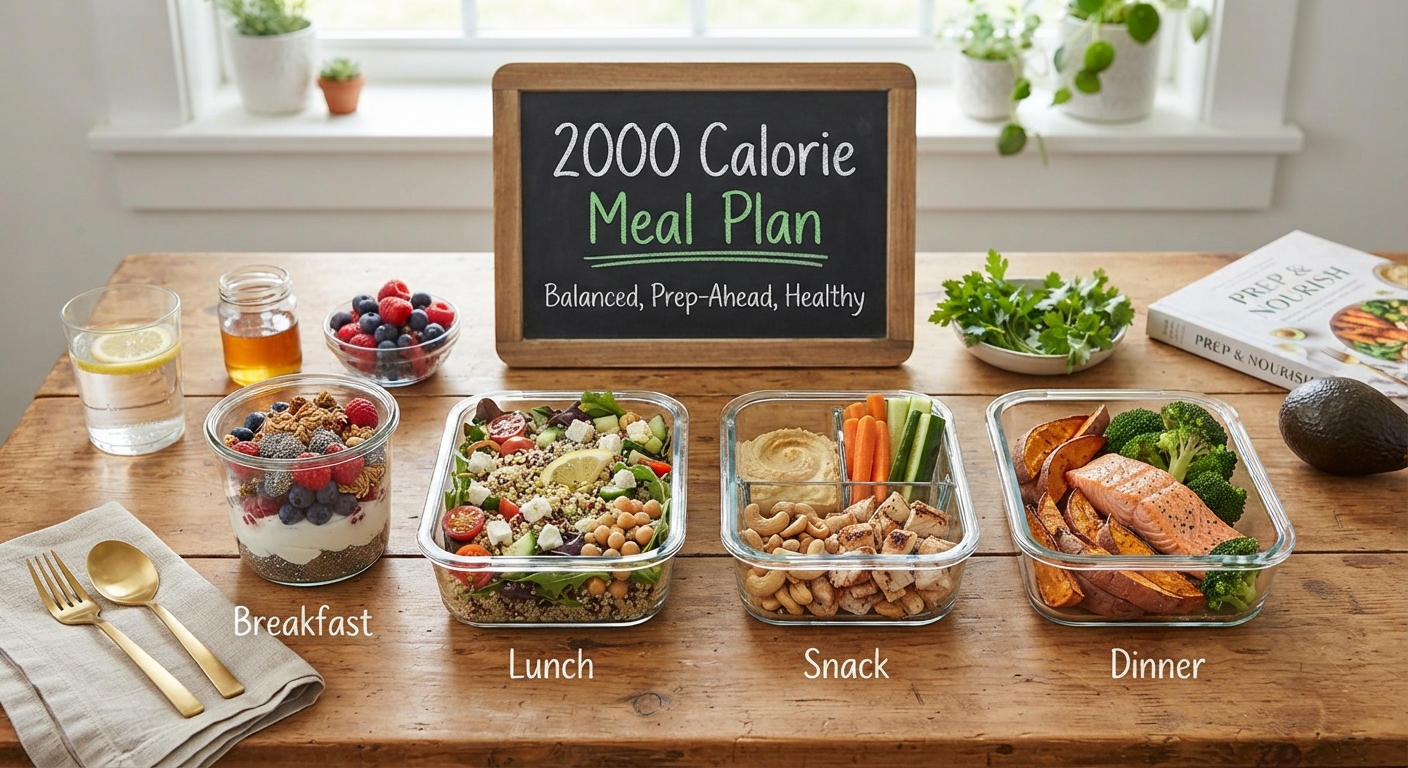
2000 Calorie Meal Plan: 2,000 calories is the number printed on every nutrition label in America — and almost nobody’s actual requirement. It’s a labeling reference, not a recommendation. That said, for a large share of adults it lands close to maintenance, which makes it the most useful plan in this series for anyone who’s finished losing weight, is building muscle, or simply wants to eat well without a deficit. Here’s the full week, plus the math to check whether 2,000 is your number or just the one on the box.
Table of Contents
Where the 2,000-Calorie Figure Comes From
The “% Daily Value” column on a nutrition panel is calculated against a 2,000-calorie reference diet. The FDA chose it as a round, representative figure for label consistency — it was never intended as a personal target, and the panel itself says as much in the footnote. Your actual requirement depends on height, weight, age, sex, and activity, and can easily range from 1,500 to 3,000.
Is 2000 Calories Your Number?
Clinical weight-loss diets generally run 1200–1500 kcal/day for women and 1500–1800 for men. 2,000 sits above both ranges, which tells you what it’s for: maintenance, muscle gain, or a gentle deficit for larger or very active people.
Worked example. A 40-year-old man, 5’9″, 195 lbs (88.5 kg), light activity:
- BMR: (10 × 88.5) + (6.25 × 175.3) − (5 × 40) + 5 = 1,786 calories
- TDEE: 1,786 × 1.375 (light activity) = 2,456 calories
- 450-calorie deficit: 2,456 − 450 = 2,006 calories
For him, 2,000 is a genuine weight-loss target producing close to a pound a week. For a 5’4″ sedentary woman with a TDEE near 1,700, the same 2,000 calories is a 300-calorie daily surplus — about half a pound gained per week. Same number, opposite outcome. That’s the whole argument for checking rather than copying.
Run yours through the Daily Diet Calculator. If it returns something lower, the 1800-calorie plan or 1500-calorie plan will fit better.
What a 2000-Calorie Day Looks Like
| Meal | Food | Calories | Protein |
|---|---|---|---|
| Breakfast | 3-egg omelet, spinach & mushrooms | 230 | 19 g |
| Whole-grain toast, 2 slices | 160 | 8 g | |
| Butter, 1 tsp | 35 | 0 g | |
| Lunch | Grilled chicken breast, 5 oz | 230 | 44 g |
| Cooked brown rice, 1 cup | 215 | 5 g | |
| Roasted vegetables, 1 cup | 60 | 2 g | |
| Olive oil, 1 tbsp | 120 | 0 g | |
| Snack | Nonfat Greek yogurt, 1 cup | 130 | 22 g |
| Mixed berries, ½ cup | 40 | 0 g | |
| Dinner | Baked salmon, 5 oz | 290 | 34 g |
| Sweet potato, 1 cup roasted | 180 | 4 g | |
| Broccoli, 1½ cups | 80 | 5 g | |
| Evening | Low-fat cottage cheese, ½ cup | 90 | 12 g |
| Almonds, 1 oz | 165 | 6 g | |
| Daily total | ~2,025 | ~161 g | |
161 g of protein is about 32% of calories — comfortably above the updated federal range for an 88.5 kg adult (106–142 g). At maintenance you have room to ease that back toward the lower end and put the calories into carbohydrate instead, particularly if you’re training hard.
The 7-Day 2000-Calorie Meal Plan
| Day | Breakfast | Lunch | Dinner | Snacks | Approx. |
|---|---|---|---|---|---|
| Mon | 3-egg omelet, 2 toast | Chicken, brown rice, roast veg | Salmon, sweet potato, broccoli | Greek yogurt + berries; cottage cheese + almonds | 2,025 / 161 g |
| Tue | Protein oats, banana, peanut butter | Leftover salmon, quinoa, greens | Turkey chili, black beans, rice | Apple + almonds; string cheese | 1,985 / 148 g |
| Wed | Greek yogurt, granola, berries | Leftover chili, side salad, bread | Lean beef mince, potatoes, green beans | Carrots + hummus; cottage cheese | 2,040 / 152 g |
| Thu | 3-egg scramble, 2 toast, ½ avocado | Tuna, chickpea & greens bowl | Chicken thigh, brown rice, roast veg | Pear; Greek yogurt + nuts | 2,010 / 150 g |
| Fri | Protein oats + peanut butter | Chicken, quinoa, roast vegetables | Baked cod, sweet potato, asparagus | Orange + almonds; cottage cheese | 1,995 / 155 g |
| Sat | Eggs, rye toast, smoked salmon, avocado | Leftover cod, mixed salad, bread | Tofu & veg stir-fry, brown rice | Greek yogurt + berries; nuts | 2,030 / 145 g |
| Sun | Cottage cheese, tomato, 2 toast, egg | Lentil soup, 2 eggs, bread | Roast chicken, potatoes, veg medley | Apple + string cheese; almonds | 2,015 / 149 g |
Using 2000 Calories for Maintenance
Maintenance is the phase most people skip, and it’s why weight comes back. Coming off a deficit, don’t jump straight from 1500 to 2000 — add roughly 150–200 calories a week and let the scale settle for a few days at each step. A small initial rise is glycogen and water refilling, not fat.
At maintenance you can also relax the protein emphasis somewhat. Muscle preservation is less fragile when you aren’t in a deficit, so the range from our breakdown of the updated federal dietary guidelines — 1.2–1.6 g/kg — is a target rather than a floor.
Using 2000 Calories to Build Muscle
If your TDEE is around 1,700–1,750, 2,000 calories is a 250–300 calorie surplus — the range that supports muscle growth while limiting fat gain. Two conditions make it work: keep protein at the upper end (1.6 g/kg or slightly above), and train with progressive resistance at least three times a week. A surplus without training is just a surplus. Our at-home strength training guide covers a starting program.
Where the Extra Calories Should Go
Moving from 1800 to 2000 gives you about 200 discretionary calories. The best uses, in rough order:
- Carbohydrate around training — the most direct performance return
- Whole-food fats — nuts, avocado, olive oil for satiety and fat-soluble vitamins
- More vegetables and fruit — fiber intake is where most people fall short
- Genuine flexibility — a dessert or a drink on a weekend, planned rather than improvised
If you’d rather build the day around a Mediterranean pattern than a macro split, our complete Mediterranean diet guide maps well onto this calorie level.
Check Your Real Target
2,000 is a label reference, not a prescription. Enter your own stats into the Daily Diet Calculator for your BMR, TDEE, goal-adjusted calorie target, and macro split — then use the plan in this series that matches. To see every step of the arithmetic, start with the TDEE calculator, and check where your weight sits for your height with the BMI calculator.
Frequently Asked Questions
Is 2000 calories a day enough to lose weight?
For larger or very active adults, yes — a man with a TDEE of 2,500 loses roughly a pound a week at 2,000 calories. For a smaller, sedentary adult whose TDEE is near 1,700, the same intake is a surplus and will cause slow weight gain. It depends entirely on your maintenance figure.
Why do nutrition labels use 2,000 calories?
It’s a standardized reference value the FDA uses so that % Daily Value figures are comparable across products. It was chosen as a representative round number for labeling purposes, not as a personal recommendation, and the label footnote says as much.
How much protein should I eat on 2000 calories?
Roughly 1.2–1.6 grams per kilogram of body weight — about 105–160 grams for most adults on this plan. Stay at the upper end if you’re training for muscle gain; the lower end is adequate at maintenance.
Can I build muscle on 2000 calories a day?
Yes, if it’s above your maintenance level. A 250–300 calorie surplus paired with high protein and consistent resistance training is the standard approach for adding muscle while limiting fat gain. Whether 2,000 creates that surplus depends on your TDEE.
Is 2000 calories too much for a woman?
Not universally. It’s near maintenance for many active women and a surplus for most sedentary ones. Rather than treating it as a gendered question, calculate your TDEE — height, weight, age, and activity matter far more than sex alone.
This meal plan is general nutrition information, not medical advice, and isn’t a substitute for guidance from a doctor or registered dietitian, particularly if you’re managing a health condition.