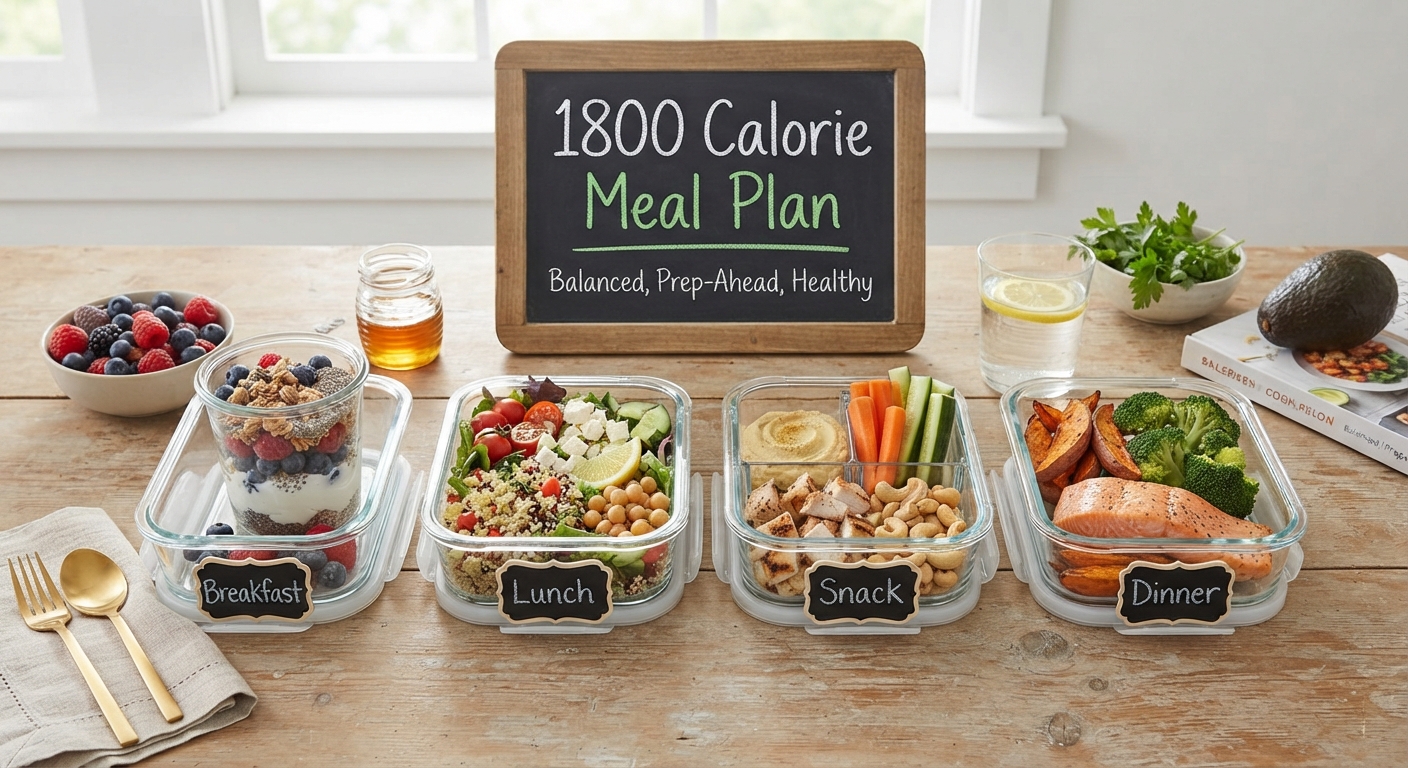
1800 Calorie Meal Plan: 1800 calories is where weight loss stops feeling like deprivation for most men and for women who train regularly. It’s also where the internet gets thin — the crowded content is all at 1200 and 1500, aimed at the smallest bodies, leaving the people who actually need 1800 to guess. This is the full week, itemized, plus the math to confirm it’s your number.
Table of Contents
Is 1800 Calories Your Target?
Clinical weight-loss guidance places conventional diets at 1500–1800 kcal/day for men and 1200–1500 for women, achieved by cutting 500–750 calories from maintenance. 1800 sits at the top of the men’s range — the sustainable end — and above the standard women’s range, which is why it suits active women rather than sedentary ones.
Worked example. A 45-year-old man, 5’8″, 185 lbs (84 kg), light activity:
- BMR: (10 × 84) + (6.25 × 172.7) − (5 × 45) + 5 = 1,699 calories
- TDEE: 1,699 × 1.375 (light activity) = 2,336 calories
- 500-calorie deficit: 2,336 − 500 = 1,836 calories
Near enough to 1800 to use this plan directly. For an active woman, the route is different but the destination can be the same: a 5’7″, 160 lb woman training four times a week has a TDEE around 2,300, making 1800 a clean 500-calorie deficit rather than an aggressive one.
Verify yours with the Daily Diet Calculator. Lower result? Use the 1500-calorie plan. Higher, or you’re at maintenance? The 2000-calorie plan is the next rung.
What an 1800-Calorie Day Looks Like
| Meal | Food | Calories | Protein |
|---|---|---|---|
| Breakfast | 3-egg omelet, spinach & mushrooms | 230 | 19 g |
| Whole-grain toast, 2 slices | 160 | 8 g | |
| Butter, 1 tsp | 35 | 0 g | |
| Lunch | Grilled chicken breast, 5 oz | 230 | 44 g |
| Cooked brown rice, 1 cup | 215 | 5 g | |
| Roasted vegetables, 1 cup | 60 | 2 g | |
| Olive oil, 1 tbsp | 120 | 0 g | |
| Snack | Nonfat Greek yogurt, 1 cup | 130 | 22 g |
| Mixed berries, ½ cup | 40 | 0 g | |
| Dinner | Baked salmon, 5 oz | 290 | 34 g |
| Sweet potato, 1 cup roasted | 180 | 4 g | |
| Broccoli, 1½ cups | 80 | 5 g | |
| Evening | Low-fat cottage cheese, ½ cup | 90 | 12 g |
| Daily total | ~1,860 | ~155 g | |
155 g of protein is about 33% of calories — high, but appropriate in a deficit and easily hit at this intake without the day feeling austere. Trim the olive oil and the evening cottage cheese if you want to land closer to a flat 1,700.
The 7-Day 1800-Calorie Meal Plan
| Day | Breakfast | Lunch | Dinner | Snacks | Approx. |
|---|---|---|---|---|---|
| Mon | 3-egg omelet, 2 toast | Chicken, brown rice, roast veg | Salmon, sweet potato, broccoli | Greek yogurt + berries; cottage cheese | 1,860 / 155 g |
| Tue | Protein oats + banana | Leftover salmon, quinoa, greens | Turkey chili, black beans, small rice | Apple + almonds; string cheese | 1,795 / 140 g |
| Wed | Greek yogurt, granola, berries | Leftover chili + side salad | Lean beef mince, potato, green beans | Carrots + hummus; cottage cheese | 1,820 / 145 g |
| Thu | 3-egg scramble, 2 toast, avocado | Tuna, chickpea & greens bowl | Chicken thigh, brown rice, roast veg | Pear; Greek yogurt | 1,840 / 142 g |
| Fri | Protein oats + peanut butter | Chicken, quinoa, roast vegetables | Baked cod, sweet potato, asparagus | Orange + almonds; cottage cheese | 1,780 / 148 g |
| Sat | Eggs, rye toast, smoked salmon | Leftover cod, big mixed salad | Tofu & veg stir-fry, brown rice | Greek yogurt + berries; nuts | 1,830 / 138 g |
| Sun | Cottage cheese, tomato, 2 toast | Lentil soup, 2 eggs, bread | Roast chicken, potatoes, veg medley | Apple + string cheese | 1,810 / 143 g |
Grocery essentials
Protein: Eggs, Greek yogurt, cottage cheese, chicken breast & thighs, salmon, cod, canned tuna, lean beef mince, turkey mince, tofu, whey protein, string cheese, lentils, black beans, chickpeas.
Carbohydrate: Brown rice, quinoa, oats, sweet potato, potatoes, whole-grain and rye bread.
Produce: Spinach, mushrooms, broccoli, asparagus, green beans, carrots, tomatoes, mixed greens, bananas, apples, pears, oranges, berries, avocado.
Fats: Olive oil, butter, almonds, peanut butter, hummus.
Protein at 1800 Calories
Updated federal guidance sets adult protein needs at roughly 1.2–1.6 g per kilogram of body weight — the change we covered in our breakdown of the new MAHA dietary guidelines. For an 84 kg man that’s 101–134 grams. This plan runs above the top of that range, deliberately, because protein needs sit higher during a deficit than at maintenance.
At 1800 calories you can hit those numbers from whole foods without a shake, which is the real advantage of this level over 1200 or 1500. Anchor each meal at 35–45 g and the day takes care of itself. Our high-protein, low-calorie foods list has the swaps; pair it with two or three resistance sessions a week using our at-home strength training guide.
Training Around This Intake
1800 calories is enough to actually train on, which changes how you should distribute food. Put most of your carbohydrate in the meals either side of your session — the brown rice, sweet potato, and oats in this plan are there for that reason. If you train in the morning, move the protein oats to pre-workout and the Greek yogurt to after. If you train after work, shift the lunch rice portion up and take dinner lighter.
If your training volume is genuinely high, 1800 may already be at or below maintenance, in which case you’re not in a deficit at all. Recheck with the TDEE calculator using an honest activity multiplier — overestimating this is the single most common error people make.
Common Mistakes at This Level
- Assuming more food means less tracking. Portion drift is easier at 1800 precisely because it feels generous.
- Front-loading the day. A 700-calorie breakfast leaves 1,100 for the rest, which is where evening snacking starts.
- Under-eating vegetables. The extra calories over a 1500-plan should not all go to grains and fats.
- Calling it a plateau too early. At a ~500-calorie deficit, meaningful change takes three to four weeks to read clearly on the scale.
Moving Up or Down
Drop to the 1500-calorie plan if loss genuinely stalls for a month at accurately tracked intake — and recalculate first, since your TDEE has likely fallen with your weight. Step up to the 2000-calorie plan when you reach maintenance or shift focus to building muscle. If you’re just starting, our step-by-step guide to starting a diet plan covers the setup, and the calorie deficit guide covers the adjustments.
Confirm Your Number First
Run your stats through the Daily Diet Calculator for a BMR, TDEE, goal-adjusted target, and macro split in seconds, then match the plan to the result. Track daily intake against it with the food calorie calculator.
Frequently Asked Questions
Will I lose weight on 1800 calories a day?
Only if 1800 is below your maintenance level. A man with a TDEE of 2,300 loses roughly a pound a week at this intake; someone with a TDEE of 1,900 loses about a fifth of that. Calculate your TDEE before assuming the number works.
Is 1800 calories enough for a man?
Yes — it sits at the sustainable top of the standard clinical range for men (1500–1800 kcal/day) and is generally easier to maintain long-term than lower targets, while better protecting muscle mass.
Is 1800 calories too much for a woman?
Not for an active one. A woman training four or more times a week often has a TDEE above 2,200, making 1800 a standard 400–500 calorie deficit. For sedentary women it usually sits at or near maintenance and won’t produce loss.
How much protein do I need on 1800 calories?
Roughly 1.2–1.6 grams per kilogram of body weight, or about 100–155 grams for most people following this plan. At this intake it’s achievable from whole foods without supplements.
Can I build muscle on 1800 calories?
If 1800 is at or slightly above your maintenance level and protein is high, yes — particularly for beginners or those returning after a break. If it’s a deficit, the realistic goal is preserving existing muscle while losing fat, not adding meaningful new mass.
This meal plan is general nutrition information, not medical advice, and isn’t a substitute for guidance from a doctor or registered dietitian, particularly if you’re managing a health condition.