
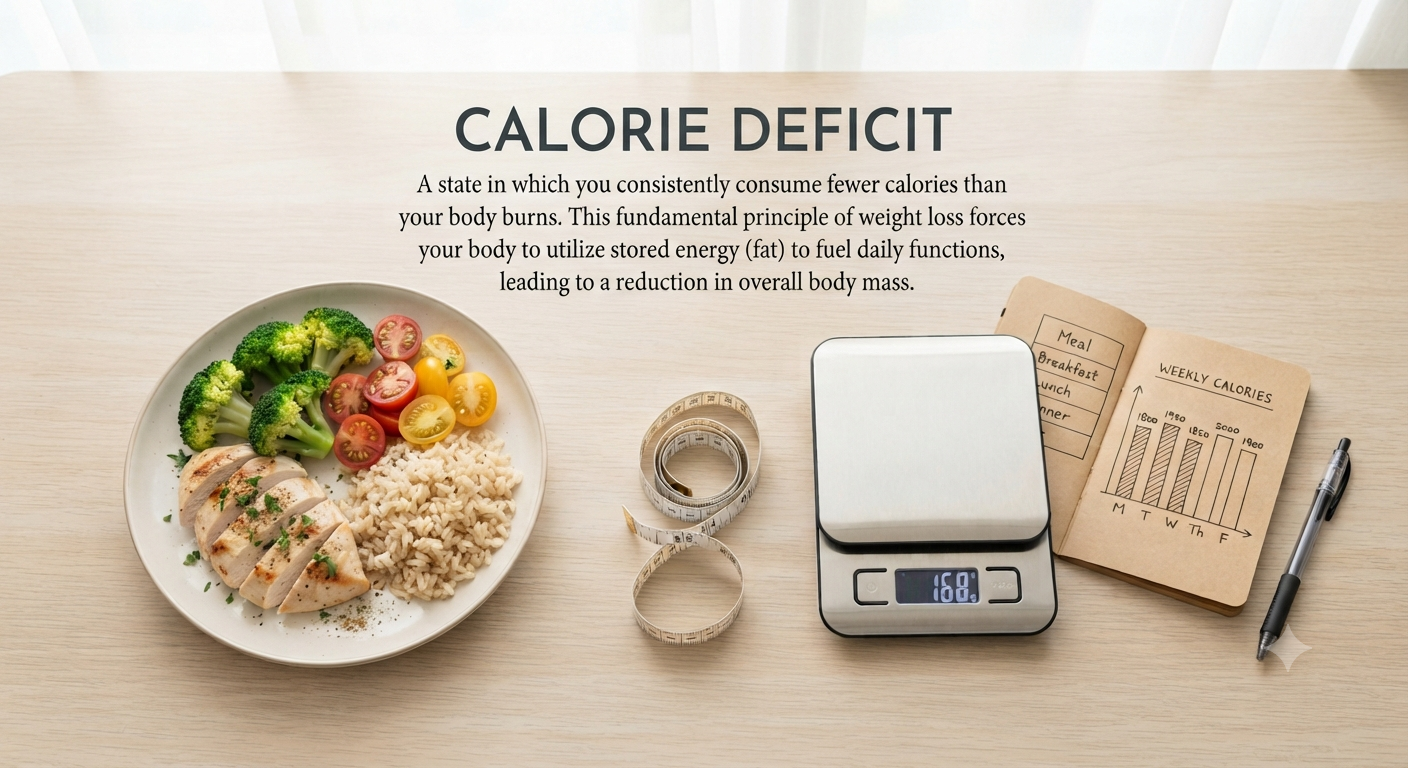
What Is a Calorie Deficit?
A calorie deficit happens when you consistently consume fewer calories than your body burns in a day. It is the single most important factor behind every successful weight loss and fat loss journey. When your body doesn’t get enough calories from food to cover its daily energy needs, it starts pulling energy from stored body fat — and that’s when the scale starts moving in the right direction.
In simple terms:
Calorie Deficit = Calories Burned (TDEE) − Calories Consumed
If you burn 2,200 calories a day and eat only 1,700, you’re in a 500 calorie deficit. Do that consistently, and your body taps into fat stores to make up the difference.
This is why every daily calorie calculator, TDEE calculator, or BMR calculator you’ll find online — including the free Calorie Deficit Calculator on this site — exists to answer one core question: how many calories should I eat to lose weight?
Calorie Deficit Calculator
Estimate your daily energy needs and target calories to reach your goal weight.
How Does a Calorie Deficit Work?
Your body needs energy for everything — breathing, digestion, walking, thinking, and exercising. This total energy need is called your Total Daily Energy Expenditure (TDEE), and it's made up of four components:
- Basal Metabolic Rate (BMR) – the energy your body uses at complete rest just to keep organs functioning. This makes up 60–70% of your total calorie burn.
- Thermic Effect of Food (TEF) – the energy used to digest, absorb, and metabolize food (roughly 10% of intake).
- Activity Energy Expenditure (AEE) – calories burned through intentional exercise like walking, strength training, or cardio.
- Non-Exercise Activity Thermogenesis (NEAT) – calories burned through everyday movement like fidgeting, standing, or house chores.
Once you know your TDEE, creating a calorie deficit is simple math: eat below that number, and your body is forced to use stored energy (fat) to cover the gap. This is the foundation of energy balance, and it's backed by decades of research, including the NIH Body Weight Planner developed by the National Institute of Diabetes and Digestive and Kidney Diseases (NIDDK), part of the National Institutes of Health (NIH).
How to Calculate Your Calorie Deficit
Calculating your deficit manually takes just three steps:
Step 1: Find Your BMR
The most common formula used by a BMR calculator is the Mifflin-St Jeor equation:
- Men: BMR = (10 × weight in kg) + (6.25 × height in cm) − (5 × age) + 5
- Women: BMR = (10 × weight in kg) + (6.25 × height in cm) − (5 × age) − 161
Step 2: Calculate Your TDEE
Multiply your BMR by an activity multiplier — or skip straight to our TDEE Calculator to get this number automatically:
| Activity Level | Multiplier |
|---|---|
| Sedentary (little to no exercise) | BMR × 1.2 |
| Lightly active (1–3 days/week) | BMR × 1.375 |
| Moderately active (3–5 days/week) | BMR × 1.55 |
| Very active (6–7 days/week) | BMR × 1.725 |
| Extremely active (athlete/physical job) | BMR × 1.9 |
Step 3: Subtract Your Deficit
Subtract 300–500 calories from your maintenance calories (TDEE) to create a healthy calorie deficit for sustainable fat loss.
👉 Skip the math — plug your numbers into our free Calorie Deficit Calculator above and get your personalized daily calorie intake instantly, along with your BMR and TDEE breakdown.
How Much Calorie Deficit Is Healthy?
This is one of the most searched questions online, and the answer matters for long-term success.
- A 500 calorie deficit per day is widely considered the gold standard. It leads to roughly 1 pound (0.45 kg) of weight loss per week, since 3,500 calories is roughly equal to one pound of body fat.
- A 300 calorie deficit is a gentler, more sustainable option — ideal for beginners or people who want slow, steady fat loss without feeling deprived.
- Deficits larger than 1,000 calories/day are generally not recommended unless supervised by a doctor, as they can cause muscle loss, nutrient deficiencies, fatigue, and metabolic slowdown.
Is a 500 Calorie Deficit Safe?
For most healthy adults, yes. A 500 calorie deficit is considered safe and sustainable for the majority of people, producing steady, healthy weight loss of about 0.5–1 kg per week without triggering excessive muscle loss or nutritional gaps — provided the diet remains balanced and nutrient-dense.
Calories to Lose 1 Pound (or 1 Kg)
- 1 pound of fat ≈ 3,500 calories → a 500-calorie daily deficit = 1 lb lost per week
- 1 kg of fat ≈ 7,700 calories → a 500-calorie daily deficit = roughly 0.45 kg lost per week
This is the exact logic every weight loss calculator and fat loss calculator uses behind the scenes. It's worth noting that real-world results vary slightly from the simple "3,500 calories = 1 pound" rule, since metabolism adapts as you lose weight — a nuance the NIH Body Weight Planner accounts for with more advanced modeling.
What Happens in a Calorie Deficit?
When you sustain a calorie deficit over time, your body goes through several physiological shifts:
- Fat stores are broken down for energy through a process called lipolysis.
- Insulin levels drop, making it easier for the body to access stored fat.
- Muscle can be preserved — or even built in some cases — if protein intake and resistance training are prioritized.
- Metabolism can adapt slightly to conserve energy, which is why deficits shouldn't be too extreme or prolonged without diet breaks.
This is also why it's possible to build muscle in a calorie deficit — especially for beginners, people returning to training, or those with higher body fat percentages — as long as protein intake and strength training are consistent. Harvard Health notes that a three-tiered approach — resistance training, sufficient protein, and a gradual pace of loss — is the most reliable way to protect lean muscle while in a deficit.
Best Foods for a Calorie Deficit
You don't need to starve yourself to lose weight. The key is choosing nutrient-dense foods that keep you full on fewer calories:
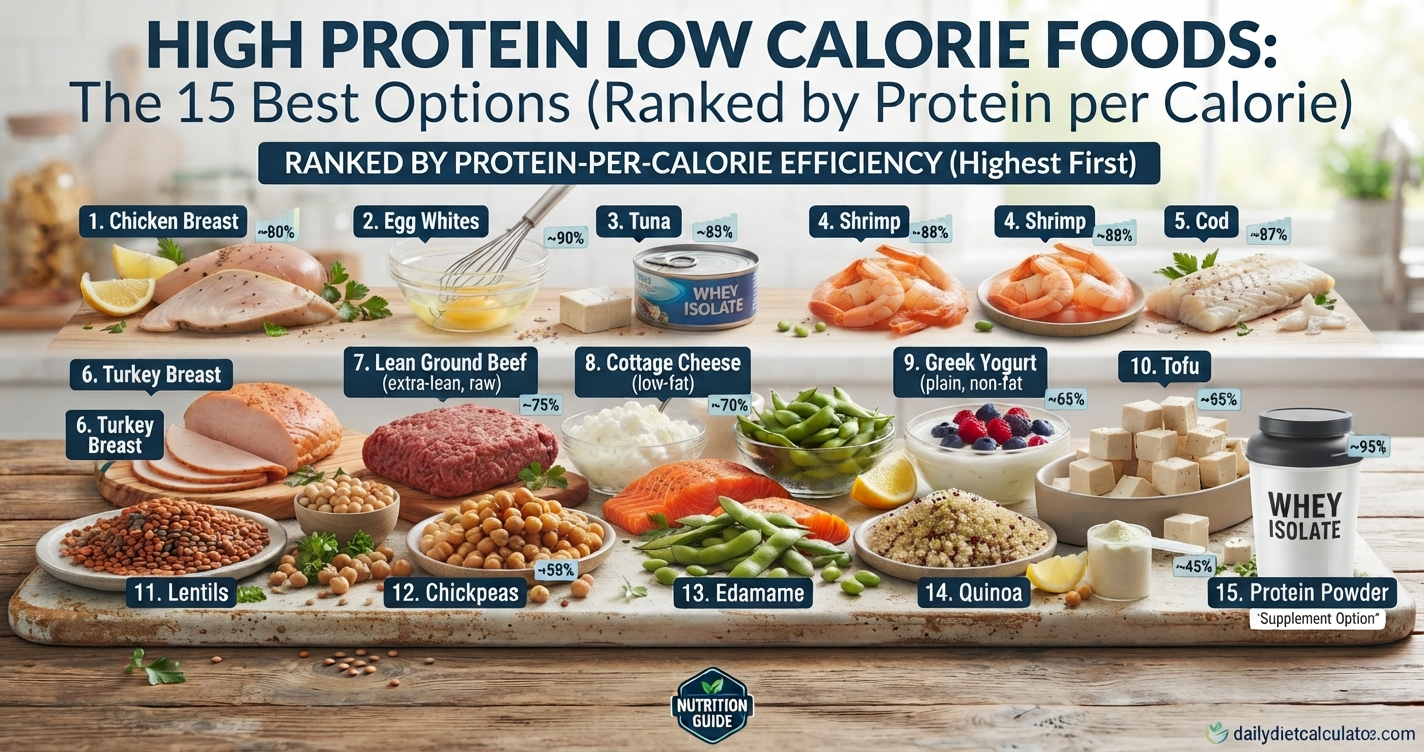
- Lean protein – chicken breast, fish, eggs, Greek yogurt, tofu, legumes
- High-fiber foods – vegetables, oats, whole grains, chia seeds, lentils
- Whole foods over processed foods — they're naturally lower in calories and higher in nutrients
- Fruits and vegetables – high volume, low calorie density, keep you satiated
- Water and unsweetened drinks instead of sugary drinks and liquid calories, which add up fast without filling you up
A high-protein diet is particularly important during a deficit — it preserves lean muscle, boosts satiety, and slightly increases calorie burn through the thermic effect of food. Use our Protein Calculator to find your ideal daily protein target based on your weight and activity level.
Can You Lose Weight Without Exercise?
Yes — weight loss is possible through diet alone, since fat loss is fundamentally about energy balance (calories in vs. calories out). However, combining a calorie deficit with physical activity — especially walking and resistance training — helps you:
- Preserve lean muscle mass
- Increase your TDEE, giving you more flexibility with food
- Improve long-term sustainable weight loss outcomes
- Support better sleep, mood, and metabolic health
The CDC recommends at least 150 minutes of moderate-intensity aerobic activity per week for adults, plus muscle-strengthening activity on two or more days — a helpful benchmark whether or not you're actively dieting.
Even light activity like a daily walk (a form of NEAT) can meaningfully increase your calories burned without adding much fatigue.
How Long Does It Take to Lose Weight?
With a consistent, healthy calorie deficit of 500 calories/day, most people can expect:
- 1 lb (0.45 kg) per week, or about 4 lbs (1.8 kg) per month
Results vary based on starting body composition, activity level, hormones, sleep, and consistency — but this range is a realistic, evidence-based benchmark rather than the exaggerated results often promised by crash diets.
Is Calorie Counting Necessary?
Not always — but it helps. Tracking your calorie intake, even loosely, builds awareness of portion sizes and food quality. Many people successfully lose weight using simpler methods like:
- Portion control (using smaller plates, the "hand-portion" method)
- Prioritizing protein and fiber at each meal
- Reducing liquid calories and processed snacks
That said, using a calorie deficit calculator at the start of your journey — even just once — gives you a clear, personalized target instead of guessing.
Calorie Deficit Meal Plan Tips
Building a sustainable calorie deficit diet doesn't require complicated meal prep. Use our Macro Calculator to split your daily calories into protein, carbs, and fat, then focus on:
- Protein at every meal (palm-sized portion) to preserve muscle and control hunger
- Half your plate as vegetables for fiber and volume
- Complex carbs like brown rice, oats, or sweet potatoes for sustained energy
- Healthy fats in moderation (nuts, olive oil, avocado)
- Home-cooked meals over restaurant or processed food to control portions and hidden calories
Home Workouts for a Calorie Deficit
You don't need a gym membership to support your deficit. Effective home-based options include:
- Bodyweight strength training (squats, push-ups, lunges) to preserve muscle
- Walking — 8,000–10,000 steps daily is a powerful, low-impact calorie burner
- Resistance band workouts for muscle maintenance
- Short HIIT or cardio sessions (15–20 minutes) to boost calorie expenditure
Frequently Asked Questions (FAQs)
How do I calculate my calorie deficit?
Find your maintenance calories (the amount you burn in a day, often estimated using the Mifflin-St Jeor formula based on weight, height, age, and activity level), then eat below that number. For example, if your maintenance is 2,200 calories and you eat 1,800, that's a 400-calorie daily deficit. Many people use online TDEE (Total Daily Energy Expenditure) calculators to get a starting estimate, then adjust based on real-world results over 2-3 weeks.
Will a calorie deficit burn belly fat?
Yes, but not exclusively. A calorie deficit causes your body to lose fat overall, and where it comes off first is largely determined by genetics — you can't target belly fat specifically through diet alone ("spot reduction" isn't supported by evidence). Some people lose belly fat relatively early, others lose it last. Strength training can help preserve muscle and improve body composition as the fat comes off, but it won't redirect fat loss to one area.
How many calories to lose 1kg?
Roughly 7,700 calories equals 1kg of body fat. So a 1,000-calorie daily deficit would theoretically lose about 1kg per week — but in practice, this number is a rough estimate, not exact. Water weight, muscle changes, and metabolic adaptation mean real results vary from person to person.
Is a 1500-calorie deficit unhealthy?
For most adults, yes, a 1,500-calorie daily deficit is too aggressive and often unhealthy. It would mean many people eating a very low number of calories overall, which can lead to muscle loss, nutrient deficiencies, fatigue, hormonal disruption, and a higher chance of bingeing or giving up. Most guidelines recommend a deficit of 500-750 calories per day for safe, sustainable fat loss (about 0.5-1kg per week). Very large deficits are typically only used short-term and under medical supervision.
What is a calorie deficit?
A calorie deficit is when you eat fewer calories than your body burns, forcing it to use stored fat for energy — the core mechanism behind all weight loss.
How much calorie deficit is healthy?
A deficit of 300–500 calories per day is considered healthy and sustainable for most adults, leading to roughly 0.5–1 kg (1–2 lbs) of weight loss per week.
Is a 500 calorie deficit safe?
Yes, for most healthy adults. It's one of the most recommended deficit sizes for steady, sustainable fat loss without excessive muscle loss.
Can I lose belly fat with a calorie deficit?
Yes. A calorie deficit reduces overall body fat, including abdominal fat, though the rate and pattern of fat loss vary by individual genetics and hormones — spot reduction isn't possible, but total fat loss includes the belly area. Track your progress with our Body Fat Calculator.
Can I build muscle in a calorie deficit?
Yes, especially for beginners or those with higher body fat, when combined with adequate protein intake and consistent resistance training.
How do I know I'm in a calorie deficit?
The most reliable way is tracking your intake against your calculated TDEE using a calorie deficit calculator, alongside monitoring consistent weight trends over 1–2 weeks (not day-to-day fluctuations).
Calculate Your Personalized Calorie Deficit Now
Stop guessing your daily calorie needs. Use our free Calorie Deficit Calculator to instantly find your BMR, TDEE, and the exact number of calories you should eat daily to lose weight — safely, sustainably, and without starving yourself.
Explore more free tools: TDEE Calculator | BMR Calculator | BMI Calculator | Macro Calculator | Protein Calculator | Body Fat Calculator | Ideal Weight Calculator | Water Intake Calculator


5 thoughts on “Calorie Deficit Calculator: The Complete Guide to Losing Weight Safely in 2026”