Most “Jamaican diet” articles online are recipe roundups wearing a weight-loss headline. They tell you to swap curry mutton for goat stew and call it a day. What they skip is the actual mechanism — why a plate built around callaloo, ackee, ground provisions, and plantain behaves differently in your body than a plate built around bread, soda, and fried snacks, even when the calorie counts look similar on paper.
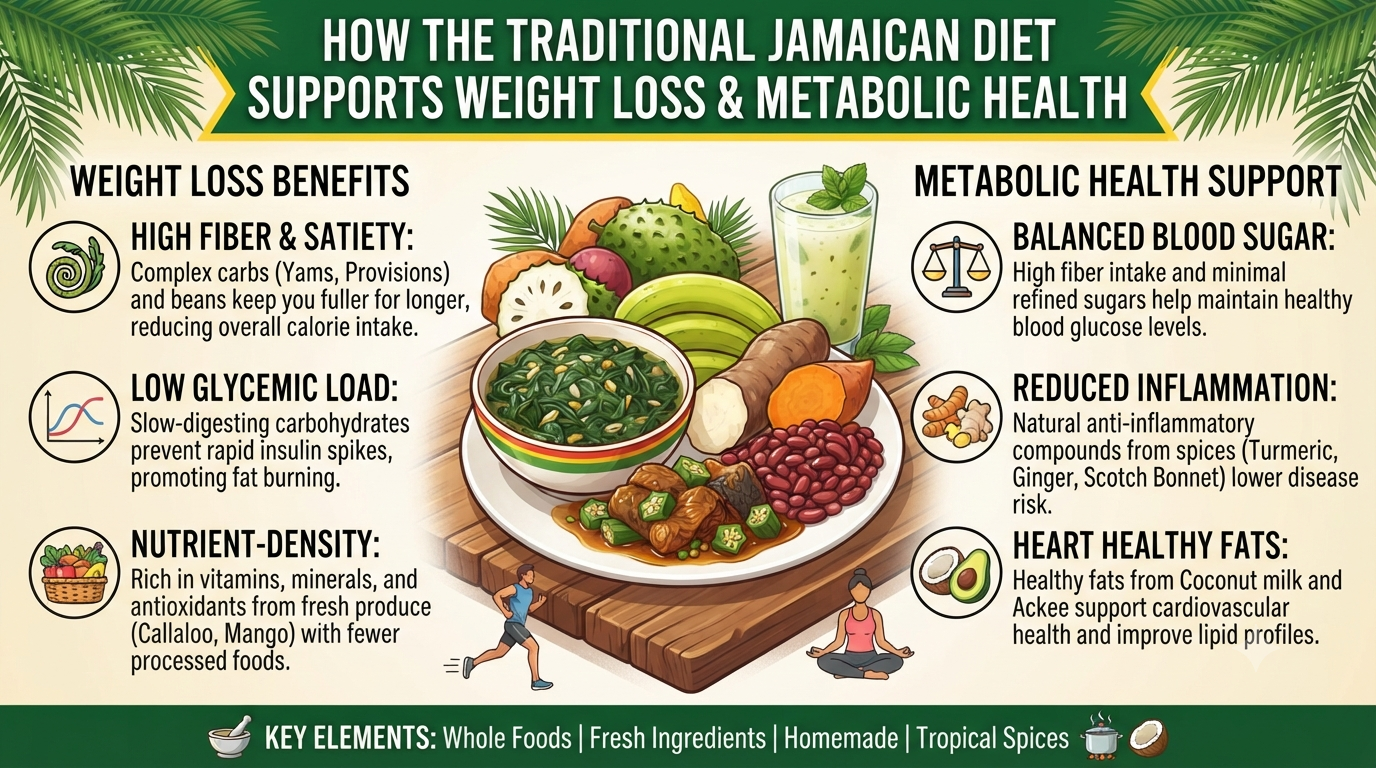
The short answer is fiber and water volume. The traditional Jamaican plate — the one eaten in rural parishes and home kitchens, not the jerk-and-festival combo sold at a roadside stand — is built almost entirely from foods with a low calorie density and a high fiber-to-calorie ratio. That combination fills the stomach before it fills the calorie budget, which is the actual physiological reason “eating clean” ever works for anyone.
Table of Contents
What “Traditional” Actually Means Here
It’s worth separating two things that get lumped together under “Jamaican food”: the everyday home diet, and the fried, sauce-heavy version sold to tourists and served at parties. Ackee and saltfish, callaloo, steamed fish, boiled green bananas, yam, and stew peas are the backbone of the traditional plate. Festival, fried dumpling, patties, and rum cake are treats — eaten, but not the daily default. A 2024 nutritionist Q&A in the Jamaica Observer made this same distinction explicit, noting that a Jamaican weight-loss plan works by keeping meals within a controlled calorie range through portion control rather than eliminating any single food.
That framing matters because it’s also the one most competing articles blur. They’ll praise callaloo’s fiber content in one paragraph and recommend a plate of festival and fried snapper in the next, without acknowledging that those two dishes behave completely differently once they hit your digestive system.
The Macronutrient Case: Fiber and Volume Without a Calorie App
The core staples of the traditional plate share a pattern: low energy density, meaningful protein or healthy fat, and a fiber load that most Western diets fall well short of. According to Harvard Health, the average American eats roughly 15–16 grams of fiber a day against a recommended 28–34 grams — about half of what’s needed. Jamaican staple crops close a large part of that gap almost by accident.
Callaloo (Amaranth Greens)
Raw amaranth greens — the base of most Jamaican callaloo — come in at roughly 23 calories per 100 grams according to USDA FoodData Central, with the leaf being over 90% water. Steamed simply with onion, garlic, and a touch of oil, a typical home-cooked serving lands in the 45–85 calorie range depending on how much fat is added, while still delivering meaningful iron, calcium, and vitamin C. The fiber and water content together create what nutrition researchers call “volumetrics” — a large, chewable portion of food for very few calories.
Ackee
Ackee, Jamaica’s national fruit, is the outlier on this list — it’s calorie-dense, not calorie-light. A 100-gram serving runs around 151 calories, carrying roughly 15 grams of fat (mostly the same monounsaturated fat profile found in avocado) and under 1 gram of carbohydrate. This is exactly why ackee and saltfish works as a satiety-driving breakfast: the fat and the fish protein together slow gastric emptying, so the meal holds you over far longer than a carb-only breakfast of the same calorie count.
Plantain and Ground Provisions
Boiled green banana, yam, and boiled (not fried) plantain are dense, starchy, and genuinely filling, with a moderate glycemic load when boiled rather than fried. The distinction matters: boiled plantain absorbs almost no additional fat, while fried plantain (a delicious, occasional side) roughly doubles the calorie count of the same portion through oil absorption. Ground provisions also carry meaningful resistant starch, which behaves more like fiber than sugar once it reaches the colon.
A Side-by-Side Macro Comparison
Numbers vary by exact preparation, but this gives a realistic per-100-gram picture of the core traditional staples versus their fried or Americanized counterparts:
| Food (100 g, as prepared) | Calories | Protein | Fat | Carbs | Fiber |
|---|---|---|---|---|---|
| Callaloo, steamed | 45–85 | 3–4 g | 0.5–5 g | 7–9 g | 2–4 g |
| Ackee (ripe, canned/boiled) | ~151 | ~3 g | ~15 g | ~1 g | ~1 g |
| Plantain, boiled | ~116 | ~1 g | ~0.3 g | ~31 g | ~2 g |
| Plantain, fried | ~220–240 | ~1.3 g | ~9–11 g | ~35 g | ~2 g |
| Festival (fried dumpling) | ~330–360 | ~5 g | ~15 g | ~45 g | <1 g |
Look at that table long enough and the pattern becomes obvious: the traditional, boiled/steamed dishes deliver bulk and nutrients for relatively few calories. The fried versions — festival, fried plantain, fried dumpling — aren’t “bad,” but they roughly double or triple the calorie cost of the same portion size without adding proportional fiber or protein. That’s the entire story of why the modern, Americanized version of Jamaican food (heavy on fried sides, light on the vegetable-forward staples) tends to derail weight loss where the traditional version supports it.
Why This Creates Satiety Without Counting Anything
Fiber and water-dense food work on hunger through mechanical and hormonal channels, not willpower. Harvard Health notes that dietary fiber helps keep body weight in check partly by adding bulk that triggers fullness signals before excess calories are consumed. The National Institute of Diabetes and Digestive and Kidney Diseases (NIDDK) similarly frames sustainable weight loss around a healthy eating plan built on vegetables, whole grains, and lean protein — not calorie deprivation.
This lines up with a genuine 2026 shift in search behavior: Google’s own mid-year trends report flagged “fibermaxxing” as a breakout wellness search, with fiber-related queries hitting an all-time high as people looked for satiety without tracking every gram. The traditional Jamaican plate was built around exactly this principle generations before it had a hashtag — heavy on greens and ground provisions, moderate on meat and starch, light on refined sugar and flour.
The Metabolic Health Angle
This isn’t just about the scale. A population-level study of metabolic syndrome among young Jamaican adults found that central obesity and low HDL cholesterol were present in a meaningful share of the study group, but that overall metabolic syndrome prevalence was comparatively low — and that both central obesity and its risk factors tracked closely with socioeconomic status and, by extension, dietary pattern. In practice, that means a diet closer to the traditional, whole-food model — high fiber, moderate lean protein, minimal refined carbohydrate — correlates with better markers even before any deliberate weight-loss effort begins.
A Worked Example: What a Real Day Looks Like
Say you’re a 34-year-old woman, 165 lbs, moderately active, with a maintenance level (TDEE) of roughly 2,100 calories. Using a standard 500-calorie deficit for about a pound a week of loss, your target lands around 1,600 calories. Here’s how a traditional Jamaican day fits that number:
| Meal | Dish | Approx. Calories | Protein |
|---|---|---|---|
| Breakfast | Ackee and saltfish (1 cup) + boiled green banana | ~385 | ~16 g |
| Lunch | Steamed callaloo (1.5 cups) + boiled yam (150 g) + grilled chicken breast (120 g) | ~470 | ~40 g |
| Snack | Mango (1 medium) + handful of roasted peanuts | ~260 | ~7 g |
| Dinner | Stew red peas (1 cup, light on coconut milk) + brown rice (½ cup) + side salad | ~440 | ~18 g |
| Total | ~1,555 | ~81 g |
That’s a 1,600-calorie target hit almost exactly, at roughly 80 grams of protein and well over 25 grams of fiber across the day — all without a single processed snack or added-sugar drink. If you want to see this run against your own numbers instead of a hypothetical, our diet calculator will generate your personal calorie and macro target from your age, weight, activity level, and goal in under a minute, and you can build a similar plate around it.
Where the Modern Version Goes Wrong
The failure mode isn’t the ingredients — it’s the drift toward the fried, sugar-heavy version of the same cuisine. A large soda with lunch, fried snapper instead of steamed, festival instead of boiled dumpling, and a heavier hand with coconut oil can add 600–800 calories to a day without changing what’s technically “on the menu.” This is the same trap most Western diets fall into: the name of the cuisine doesn’t determine the calorie outcome, the preparation does.
If you’re not sure how much of a swing that represents for your own numbers, running a plate through our food calorie calculator makes the fried-versus-boiled gap concrete rather than abstract.
How to Build Your Own Jamaican-Inspired Plate
- Anchor lunch and dinner in a leafy green or vegetable base — callaloo, pumpkin, okra, or cho-cho — before adding starch or protein.
- Pick one starch, boiled or steamed — yam, green banana, breadfruit, or plantain — rather than stacking rice, dumpling, and plantain on the same plate.
- Treat ackee, coconut milk, and fried sides as flavor, not filler — a spoonful goes a long way and keeps the fat contribution reasonable.
- Prioritize lean protein at each meal — steamed fish, grilled chicken, or saltfish in moderation — to extend satiety between meals. Our high-protein, low-calorie foods list is a useful cross-reference if you’re building meals outside Jamaican cuisine too.
- Know your number before you build the plate. Portion control only works if you know what you’re controlling toward — start with our TDEE calculator to find your maintenance level, then apply the deficit logic from our calorie deficit guide.
If you want the full structure — a week of meals, not just a single day — our complete weight loss diet plan guide walks through how to build a sustainable week around whatever cuisine you actually enjoy eating, Jamaican or otherwise.
Jamaican Diet FAQ
Is Jamaican food good for weight loss?
The traditional, home-style version — built around callaloo, ground provisions, steamed fish, and moderate portions of rice and peas — is genuinely supportive of weight loss because of its fiber and water content. The fried, restaurant-style version can work too, but requires more attention to portion size and cooking oil.
How many calories are in ackee and saltfish?
A typical prepared serving runs around 300–385 calories depending on portion size and how much saltfish and oil are used, with roughly 16 grams of protein per serving.
Is callaloo good for weight loss?
Yes. Callaloo is low in calories relative to its volume and fiber content, and it’s typically eaten in large portions relative to its calorie cost, which supports fullness without a large calorie contribution.
Can you eat Jamaican food on a calorie deficit?
Yes — the worked example above shows a full day of traditional Jamaican meals landing almost exactly on a 1,600-calorie deficit target with over 80 grams of protein. The key is favoring boiled and steamed preparations over fried ones and keeping portions of dense sides like festival or fried dumpling occasional rather than daily.
What is the traditional Jamaican diet based on?
It’s centered on leafy greens (callaloo), ground provisions (yam, green banana, breadfruit), plantain, legumes (red peas, gungo peas), and fish or lean meat, with ackee and coconut milk used as flavor components rather than the bulk of the meal.
This article is for general nutrition and fitness guidance only and isn’t a substitute for advice from a doctor or registered dietitian — consult one before making major changes to your diet.