Almost every 1200-calorie meal plan online starts the same way — here are the meals, here’s the shopping list, good luck. None of them stop to ask the obvious question: where did 1200 come from, and is it right for the person reading? For a lot of people it isn’t. This plan gives you the full seven days, itemized with real numbers, but it starts by checking the target.
Table of Contents
First: Is 1200 Calories Actually Your Number?
1200 calories per day is not a weight-loss target. It’s a floor — the lowest intake most clinical protocols will prescribe for women without medical supervision. A review in Reviews in Endocrine and Metabolic Disorders describes conventional weight-loss diets as cutting 500–750 calories per day from maintenance, typically landing at 1200–1500 kcal/day for women and 1500–1800 kcal/day for men. Notice that 1200 sits at the bottom of the bottom range.
Here’s what that means in practice. Take a 45-year-old woman, 5’2″, 130 lbs (59 kg), sedentary desk job. Running the Mifflin-St Jeor equation:
- BMR: (10 × 59) + (6.25 × 157.5) − (5 × 45) − 161 = 1,188 calories
- TDEE: 1,188 × 1.2 (sedentary) = 1,426 calories
- Standard 500-calorie deficit: 1,426 − 500 = 926 calories
A textbook deficit would put her below the safe floor. That’s the signal to take a smaller deficit — around 250–300 calories, landing her near 1,150–1,175 — and accept slower loss, rather than eat at 926. For her, 1200 is roughly right. For a 5’8″ woman at 190 lbs, the same math produces a TDEE near 2,100 and a sensible target closer to 1,600. Eating 1200 would mean a 900-calorie deficit: unnecessary, hard to sustain, and a fast route to muscle loss.
Run your own numbers before you use this plan. Our diet calculator does the Mifflin-St Jeor math, applies your activity multiplier, and returns a goal-adjusted target with a macro split. If it hands you 1,500 or 1,800, use the 1500-calorie plan or the 1800-calorie plan instead. A plan built for the wrong number isn’t a plan.
When 1200 calories is a reasonable target
- Shorter, sedentary or lightly active women whose TDEE lands under about 1,700
- Someone whose calculated deficit target would otherwise fall below 1,200
- Short-term use under a dietitian’s or physician’s guidance
When it isn’t
- Men — nearly always. Clinical ranges start at 1,500 for men; see the 1500-calorie plan
- Anyone training hard or physically active at work
- Pregnancy, breastfeeding, or adolescence
- Anyone with a history of disordered eating, without clinical supervision
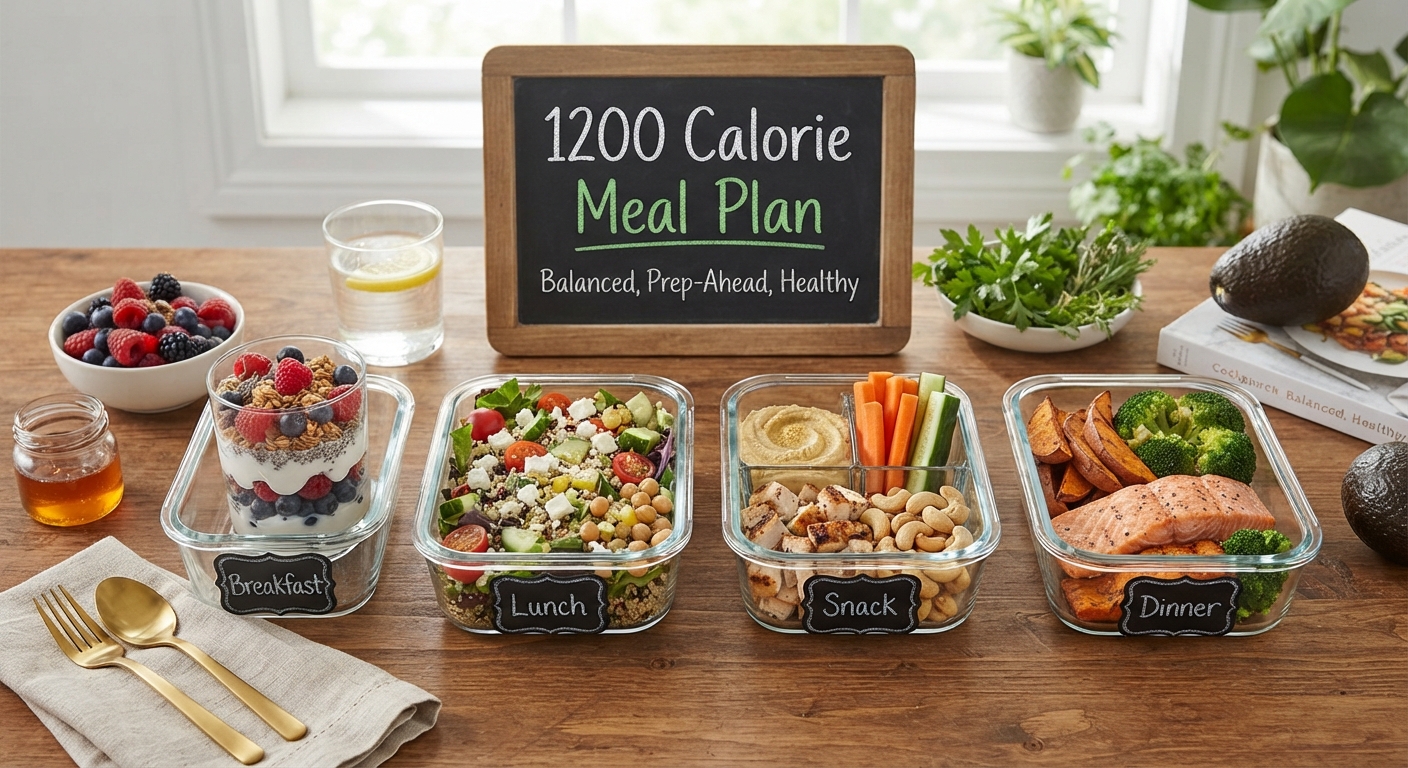
What a 1200-Calorie Day Actually Looks Like
The hard part at this calorie level isn’t calories, it’s protein. Cut intake this low without protecting protein and a meaningful share of what you lose is muscle. This day is built protein-first — every item earns its place.
| Meal | Food | Calories | Protein |
|---|---|---|---|
| Breakfast | Nonfat Greek yogurt, 1 cup | 130 | 22 g |
| Blueberries, ½ cup | 40 | 0 g | |
| Chia seeds, 1 tbsp | 60 | 2 g | |
| Lunch | Grilled chicken breast, 4 oz | 185 | 35 g |
| Mixed greens, 2 cups | 20 | 2 g | |
| Chickpeas, ½ cup | 120 | 6 g | |
| Olive oil + vinegar, 1 tsp | 40 | 0 g | |
| Snack | Medium apple | 95 | 0 g |
| Almonds, ½ oz (about 11) | 82 | 3 g | |
| Dinner | Baked cod, 4 oz | 110 | 24 g |
| Roasted broccoli, 1 cup | 55 | 4 g | |
| Cooked quinoa, ½ cup | 110 | 4 g | |
| Olive oil, 1 tsp | 40 | 0 g | |
| Evening | Low-fat cottage cheese, ½ cup | 90 | 12 g |
| Daily total | ~1,177 | ~114 g | |
114 grams of protein is roughly 456 calories — about 39% of the day. That ratio looks extreme against standard macro advice, and it’s deliberate. At a low intake the priority shifts from balance to preservation: keep protein high, keep fat adequate for hormone function, and let carbohydrate take the cut. For more ways to hit these numbers cheaply, see our high-protein, low-calorie foods list.
The 7-Day 1200-Calorie Meal Plan
Every day below lands between roughly 1,150 and 1,220 calories with 100 g or more of protein. Days repeat ingredients on purpose — fewer items means less waste and less decision fatigue.
| Day | Breakfast | Lunch | Dinner | Snacks | Approx. |
|---|---|---|---|---|---|
| Mon | Greek yogurt, berries, chia | Chicken & chickpea salad | Baked cod, broccoli, quinoa | Apple + almonds; cottage cheese | 1,180 / 114 g |
| Tue | 2-egg veggie scramble + 1 slice rye | Leftover cod, big green salad | Turkey chili with beans | Pear; string cheese | 1,205 / 105 g |
| Wed | Protein oats (½ cup oats + scoop whey) | Leftover turkey chili | Grilled chicken, roasted veg, sweet potato | Carrots + hummus; Greek yogurt | 1,190 / 108 g |
| Thu | Greek yogurt, berries, chia | Tuna (in water) on greens, ½ avocado | Baked tofu stir-fry, cauliflower rice | Orange; cottage cheese | 1,160 / 102 g |
| Fri | 2-egg scramble + 1 slice rye | Chicken & chickpea salad | Baked salmon, asparagus, ½ cup quinoa | Apple + almonds | 1,215 / 106 g |
| Sat | Protein oats | Leftover salmon, mixed greens | Lean beef mince, zucchini, small potato | Berries + Greek yogurt | 1,200 / 110 g |
| Sun | Cottage cheese, tomato, rye toast | Lentil & vegetable soup + egg | Roast chicken thigh (skinless), veg medley | Pear; string cheese | 1,175 / 101 g |
The short grocery list
Protein: Greek yogurt, cottage cheese, eggs, chicken breast & thighs, cod, salmon, canned tuna, lean beef mince, firm tofu, whey protein, string cheese, lentils, chickpeas, black beans.
Produce: Mixed greens, broccoli, asparagus, zucchini, cauliflower, carrots, tomatoes, sweet potato, apples, pears, oranges, berries, avocado.
Pantry: Oats, quinoa, rye bread, olive oil, chia seeds, almonds, hummus, vinegar, spices.
Protecting Muscle at 1200 Calories
The updated federal dietary guidance now puts adult protein needs at roughly 1.2–1.6 grams per kilogram of body weight, well above the old 0.8 g/kg standard — a shift we covered in our breakdown of the new Make America Healthy Again dietary guidelines. For our 59 kg example, that’s 71–94 grams daily. This plan clears the top of that range, which is the point: the deeper the deficit, the more protein has to do to keep lean mass on your frame.
Two things matter as much as the number. Spread it across the day rather than loading dinner — roughly 25–30 g per meal. And lift something twice a week. A calorie deficit tells the body it can afford to shed tissue; resistance training is the signal that muscle isn’t the tissue to shed. Our full-body strength training at home guide needs no equipment.
Five Mistakes That Sink 1200-Calorie Plans
- Untracked cooking fat. A free pour of olive oil is 120 calories — 10% of the day. Measure it.
- Treating 1200 as a ceiling to undershoot. Eating 900 because you “weren’t hungry” turns an aggressive plan into an unsafe one.
- Liquid calories. A large flavored latte can be 250 calories with negligible protein. Log drinks in our food calorie calculator.
- Cutting fat to almost nothing. Under about 40 g/day, satiety and hormone function suffer. Fat isn’t the enemy here; volume is the constraint.
- Staying at 1200 forever. As weight drops, TDEE drops. Recalculate every 5–10 lbs and expect to move up a level once you’re maintaining.
When to Move Up the Ladder
This plan is the bottom rung of a four-level ladder, and most people shouldn’t stay on it long. Move up when you’re persistently exhausted, your training performance collapses, your loss stalls for three-plus weeks at a genuinely tracked intake, or you reach maintenance. The next steps: 1500 calories for moderate deficits and most smaller men, 1800 calories for active women and average-build men, and 2000 calories for maintenance or lean-gain. Our calorie deficit guide covers how to time those moves.
Ready to Check Your Own Target?
Don’t inherit someone else’s number. Enter your height, weight, age, sex, and activity level into the Daily Diet Calculator and get your BMR, TDEE, goal-adjusted calorie target, and macro split in about ten seconds — then pick the plan in this series that matches what it returns. If you want the underlying math shown step by step first, our TDEE calculator walks through every stage.
Frequently Asked Questions
Is 1200 calories a day safe?
For many smaller, sedentary women it’s within accepted clinical ranges — conventional weight-loss diets are typically prescribed at 1200–1500 kcal/day for women. It is generally considered a floor rather than a goal, and going below it without medical supervision isn’t advised. For most men, 1500 is the comparable starting point.
How much weight will I lose on 1200 calories a day?
It depends entirely on your maintenance level. If your TDEE is 1,700, a 1200-calorie intake is a 500-calorie daily deficit — roughly one pound per week, since a pound of fat is about 3,500 calories. If your TDEE is 1,450, the same intake produces closer to half a pound weekly. Calculate your TDEE first.
How much protein should I eat on a 1200-calorie diet?
Aim for 1.2–1.6 grams per kilogram of body weight — roughly 90–115 grams for most women following this plan. Protein is the single most important variable at low intakes because it’s what preserves muscle while you’re in a deficit.
Why am I not losing weight on 1200 calories?
The most common causes are untracked intake (cooking oils, drinks, tastes while cooking), an overestimated activity multiplier, or a TDEE that has fallen as you’ve lost weight. Normal water-weight fluctuation can also mask real fat loss for two to three weeks. Recalculate your target and track for a full fortnight before changing anything.
Is 1200 calories enough for a man?
Almost never. Clinical weight-loss ranges for men typically start at 1500 kcal/day and run to 1800. A man eating 1200 is usually in a deficit large enough to cost significant muscle mass.
This meal plan is general nutrition information, not medical advice, and isn’t a substitute for guidance from a doctor or registered dietitian. Talk to a professional before starting a low-calorie diet, particularly if you’re managing a health condition, are pregnant or breastfeeding, or have any history of disordered eating. If you’re struggling with your relationship with food, the National Alliance for Eating Disorders helpline (1-866-662-1235) offers free, confidential support from licensed clinicians.