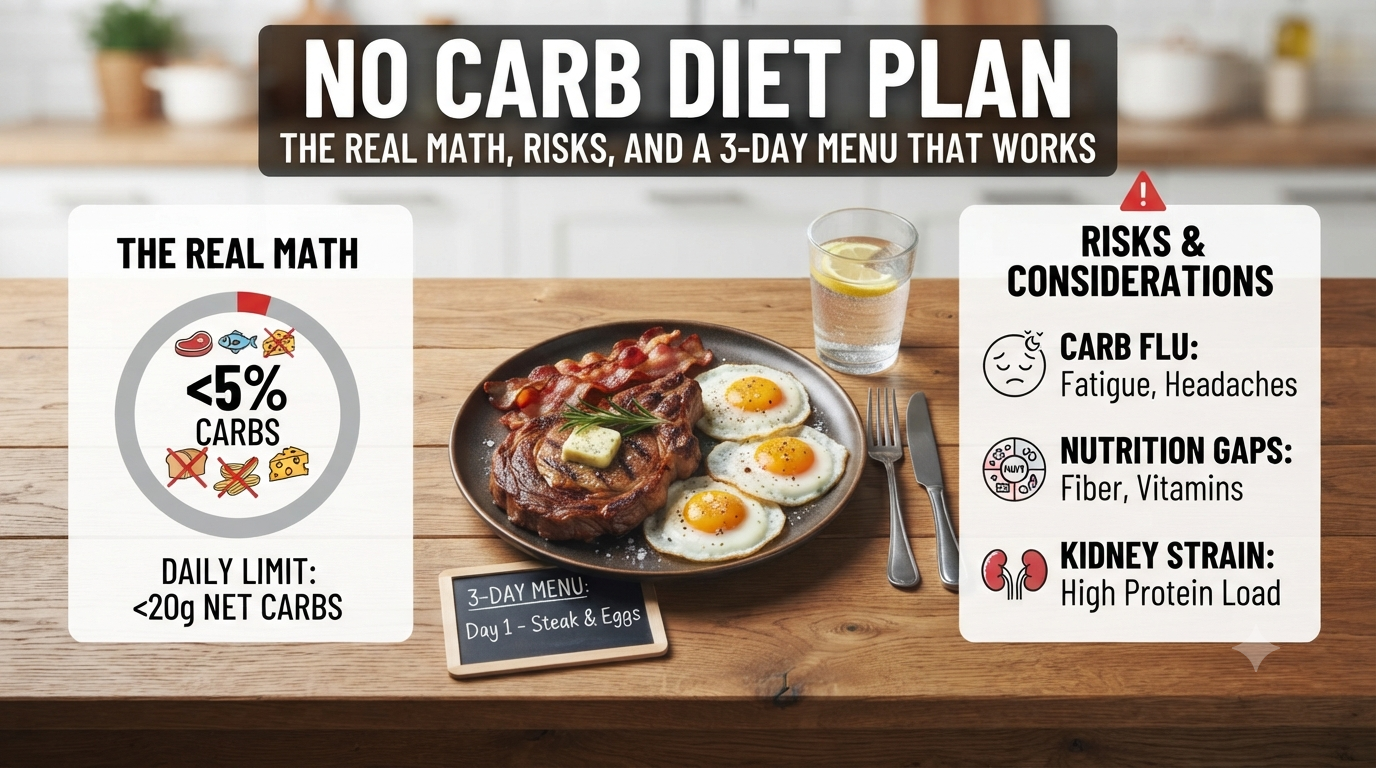
Type “no carb diet plan” into Google and you’ll get a dozen articles telling you to eat meat, eggs, and cheese while avoiding “carbs.” Almost none of them tell you how many calories that actually adds up to, what happens to your body chemistry by day four, or which version of this diet — zero-carb, keto, or garden-variety low-carb — you’re even talking about. That gap matters, because the difference between 20 grams of carbs a day and 0 grams a day is the difference between a sustainable eating pattern and one that can leave you short on fiber, vitamin C, and patience within a week.
This guide breaks the no carb diet plan down the way a dietitian would: what it is, what the actual math looks like for someone at your size and activity level, a real 3-day menu with numbers attached, and — critically — who should not attempt it at all.
Table of Contents
What a No Carb Diet Plan Actually Means
There’s no regulatory or clinical definition of “no carb,” which is part of why the term gets used so loosely. According to a clinical review on the NCBI Bookshelf, low-carbohydrate approaches are generally split into two working categories: “low-carbohydrate” (under about 26% of calories from carbs, or roughly 130 g/day) and “very low-carbohydrate,” which falls in the 20–50 g/day range — the zone most people associate with ketosis (NCBI StatPearls, Low-Carbohydrate Diet). A true zero-carb or “no carb” diet pushes past that floor, restricting intake to under 10 g/day — usually just trace carbs from herbs, spices, and the occasional condiment.
In practice, a strict no carb diet plan means building every meal around meat, poultry, fish, eggs, and hard cheese, and cutting out every plant food that contains digestible carbohydrate: grains, legumes, fruit, starchy vegetables, and — in the strictest version — even non-starchy vegetables like broccoli or spinach.
No Carb vs. Zero Carb vs. Keto vs. Low Carb
| Approach | Daily Carb Range | Typical Foods | Fiber Included? |
|---|---|---|---|
| Low-carb | 50–130 g/day | Meat, eggs, dairy, non-starchy vegetables, some fruit, nuts | Yes |
| Keto | 20–50 g/day | Meat, eggs, cheese, leafy greens, avocado, oils | Yes, but minimal |
| Very low-carb / “no carb” | Under 10 g/day | Meat, fish, eggs, hard cheese, animal fats | Little to none |
| Zero-carb / carnivore | 0 g/day (true zero) | Meat, fish, eggs, animal fat only | None |
Most people who say they’re doing a “no carb diet plan” are actually somewhere between the third and fourth row — closer to zero than to keto, but still allowing the occasional trace-carb seasoning or a splash of heavy cream in coffee.
The Math Behind a No Carb Diet Plan
Here’s where most articles on this topic stop short. Removing carbs doesn’t remove the need to hit a calorie and protein target — it just forces your body to source nearly all of its energy from fat and protein instead of the roughly 45–65% of calories that carbohydrates normally supply for most adults.
Say you’re a 35-year-old woman, 165 lbs, moderately active, aiming to maintain weight rather than lose it. Using the Mifflin-St Jeor equation, her total daily energy expenditure (TDEE) lands around 2,200 calories. On a standard diet, roughly 45% of that (about 250 g) would come from carbs. Strip carbs out entirely and those calories have to go somewhere else:
| Macronutrient | Standard Diet (2,200 kcal) | No Carb Diet Plan (2,200 kcal) |
|---|---|---|
| Carbohydrate | ~250 g (45%) | 0–10 g (<2%) |
| Protein | ~110 g (20%) | ~150–170 g (28–31%) |
| Fat | ~75 g (31%) | ~165–180 g (68–70%) |
That’s the part rarely spelled out: on a true no carb diet plan, fat isn’t a side effect — it becomes the majority of your calorie intake by design, since protein above roughly 35% of calories gets harder to digest comfortably and can be partially converted to glucose anyway. If you want your own numbers instead of this example, run your stats through our diet calculator, which calculates BMR, TDEE, and a goal-adjusted macro split using the same Mifflin-St Jeor formula, or use the standalone TDEE calculator to see the step-by-step math behind your maintenance number before you start subtracting carbs from it.
Foods to Eat and Foods to Avoid
Foods That Fit a No Carb Diet Plan
- Beef, lamb, pork, and other red meats
- Poultry — chicken, turkey, duck
- Fish and shellfish
- Eggs
- Hard, aged cheeses (in moderation — some soft cheeses carry trace carbs)
- Animal fats — butter, tallow, lard
- Oils — olive oil, avocado oil
- Bone broth, black coffee, plain tea, water
Foods That Don’t Fit
- Grains and anything made from them (bread, pasta, rice, oats)
- Legumes and beans
- Fruit, including berries
- Starchy vegetables — potatoes, corn, squash
- Non-starchy vegetables (in the strict/zero-carb version)
- Milk and most yogurts (natural lactose content)
- Sugars, sauces, and most condiments
Sample 3-Day No Carb Meal Plan (With Real Numbers)
This plan targets roughly 2,000 calories a day for a moderately active adult. Adjust portions up or down based on your own target from the free calorie calculator.
| Day | Meal | Menu | Approx. Calories | Protein / Fat |
|---|---|---|---|---|
| Day 1 | Breakfast | 3 whole eggs + 3 bacon strips, cooked in butter | ~430 kcal | 26 g / 34 g |
| Lunch | 6 oz grilled chicken thigh with skin | ~460 kcal | 42 g / 32 g | |
| Dinner | 8 oz ribeye steak + 1 tbsp butter | ~820 kcal | 60 g / 64 g | |
| Day 2 | Breakfast | 4 fried eggs in butter, 2 oz cheddar | ~560 kcal | 32 g / 46 g |
| Lunch | 6 oz canned tuna in oil + mayonnaise | ~430 kcal | 38 g / 28 g | |
| Dinner | 8 oz pork chop pan-seared in lard | ~640 kcal | 54 g / 44 g | |
| Day 3 | Breakfast | 4 oz smoked salmon + 2 boiled eggs | ~410 kcal | 34 g / 27 g |
| Lunch | 6 oz ground beef (80/20) patty, no bun | ~470 kcal | 38 g / 34 g | |
| Dinner | 10 oz roast lamb + rendered fat drippings | ~780 kcal | 62 g / 58 g |
Every meal here is built the same way: a protein anchor, cooked in or finished with animal fat, with zero plant-based carbohydrate. It’s monotonous by nature — variety mostly comes from swapping cuts of meat and cooking fat, not ingredient categories. If tracking every gram like this feels like a lot, our food calorie calculator lets you log individual foods against your daily target instead of doing the math by hand for every meal.
What the Research Actually Shows
The most rigorous data here doesn’t come from diet blogs — it comes from a controlled inpatient trial run by the National Institute of Diabetes and Digestive and Kidney Diseases (NIDDK), part of the NIH. Researchers housed 20 adults in a metabolic research unit for four weeks and compared a low-carbohydrate, animal-based diet to a low-fat, plant-based diet, measuring actual food intake rather than relying on self-report. The low-fat group ended up eating less overall, but also ran higher blood sugar and insulin readings than the low-carb group did (NIH Research Matters, 2021). Both groups lost weight over the study period, yet only the low-fat arm showed a statistically meaningful drop in body fat specifically — a distinction that rarely makes it into “no carb” marketing copy.
The lead researcher, NIDDK’s Kevin Hall, was explicit that the study wasn’t designed to hand out weight-loss recommendations, and results were measured in a tightly controlled lab setting that’s hard to replicate at home. That’s an important caveat: short controlled trials tell you what happens metabolically, not necessarily what happens to your grocery bill and social life over six months.
Risks and Who Should Avoid a No Carb Diet Plan
Cutting carbs to near zero does more than change what’s on your plate — it changes your body’s fuel source entirely, and that transition isn’t free. According to the Mayo Clinic, pushing carbs down this hard forces the body to convert fat into ketones for fuel, a state known as ketosis, which commonly brings on headaches, fatigue, weakness, and bad breath in the first week or two (Mayo Clinic). Mayo also flags that sustained long-term carb restriction can leave gaps in vitamin and mineral intake and lead to digestive issues — a real concern once fiber-containing plant foods disappear entirely from the plate.
Harvard Health raises a separate flag around cognitive effects: the brain runs most efficiently on glucose, and cutting carbohydrates too aggressively has been linked to confusion and irritability in some people (Harvard Health). Harvard’s review also points to the diet’s typically high saturated-fat content as a cardiovascular concern worth discussing with a doctor before starting.
A no carb diet plan is not appropriate — or is at minimum a conversation for your doctor first — if you:
- Are pregnant or breastfeeding
- Have a history of an eating disorder
- Have kidney disease (high protein intake increases renal workload)
- Have liver disease or gallbladder issues
- Take insulin or other blood-sugar-lowering medication
- Have a personal or family history of heart disease and high LDL cholesterol
Even outside those groups, most registered dietitians would rather see a moderate low-carb approach — the kind that still includes fibrous vegetables — over a true zero-carb plan, simply because the nutrient gaps are easier to avoid.
How to Start a No Carb Diet Plan Safely
- Calculate your real maintenance calories first. Don’t guess — use the diet calculator to get your BMR, TDEE, and a goal-adjusted target before you touch your carb intake.
- Taper instead of cutting cold. Dropping from a typical 250 g/day of carbs straight to zero often triggers the worst of the “keto flu” symptoms. Stepping down over 7–10 days is gentler.
- Front-load electrolytes. Sodium, potassium, and magnesium losses are common in the first two weeks as your body sheds glycogen-bound water — bone broth and adding salt to meals helps.
- Set a hard time limit. Treat a strict no carb diet plan as a short experiment (2–4 weeks), not a permanent lifestyle, and reassess with bloodwork if you continue past that.
- Track intake against a real target. Log meals with the food calorie calculator so “no carb” doesn’t quietly turn into “no calorie limit either.”
If the idea of eliminating an entire macronutrient feels extreme, it’s worth comparing against a standard calorie-deficit approach first — for many people the results are similar without the restriction. Our calorie deficit guide walks through that math, and the step-by-step guide to starting a diet plan covers the broader process of choosing an approach that actually fits your life.
No Carb Diet Plan FAQ
Is a no carb diet the same as keto?
No. Keto typically allows 20–50 g of carbs a day from sources like leafy greens and avocado. A true no carb or zero-carb diet pushes below 10 g a day and often excludes vegetables entirely, relying almost exclusively on animal foods.
How much weight can you lose on a no carb diet plan?
Early, rapid loss in the first one to two weeks is mostly water weight, as your body depletes glycogen stores that are bound to water. Fat loss beyond that point still depends on maintaining a calorie deficit, not the carb count itself — use a TDEE calculator to confirm you’re actually in a deficit rather than assuming zero carbs guarantees one.
Can you eat vegetables on a no carb diet?
In a moderate low-carb approach, yes — non-starchy vegetables like broccoli, spinach, and peppers contain very few net carbs. In a strict zero-carb or carnivore-style plan, no plant foods are included at all.
What are the biggest risks of cutting carbs completely?
Nutrient and fiber deficiencies, ketosis-related side effects (fatigue, headache, bad breath), digestive issues, and — with prolonged high saturated-fat intake — a potential rise in LDL cholesterol. Anyone with kidney, liver, or heart conditions should talk to a doctor before attempting it.
Is a no carb diet plan sustainable long-term?
Most dietitians consider it a short-term tool rather than a long-term lifestyle, largely because of the difficulty maintaining adequate micronutrient intake without any plant foods. A moderate low-carb pattern is generally viewed as easier to sustain.
Whatever version of low-carb eating you land on, the number that actually determines whether you lose, maintain, or gain weight is still your total calorie balance. Start there: run your stats through the Daily Diet Calculator to get a personalized calorie and macro target before you decide how many of those calories should come from carbs.