7-Day Meal Plan · Weight Loss
The 7-Day Diet Plan for Weight Loss That Actually Explains Itself
Most week-long diet plans hand you a rigid menu and no explanation. This one gives you the calorie science, the exact protein and fiber targets, a full seven days of meals, and — just as important — a plan for what to do on Day 8.
If you want this calibrated to your own body instead of a generic template, start with your numbers.
The Mechanism
How weight loss actually works in seven days
Weight loss happens when you consistently take in fewer calories than your body burns — a state known as a calorie deficit. One pound of body fat is roughly equivalent to 3,500 calories, so a daily deficit of 500–750 calories translates to a realistic pace of loss.
That pace isn’t arbitrary. It’s what the CDC recommends, because people who lose weight gradually are more likely to keep it off — and it’s echoed by Harvard Health, which notes that faster loss tends to burn muscle along with fat and can slow metabolism in the process.
That’s the gap most “lose weight in 7 days” articles skip: in a single week, most of what moves on the scale is water weight and reduced digestive bulk, not fat loss in the strict sense. The real value of this week is that it resets your habits and gives your body a template you can repeat.
For the full math behind your own number, see our calorie deficit guide.
Step 1
Find your actual calorie target
Nearly every generic 7-day plan online defaults to 1,200–1,500 calories, regardless of who’s reading it. A sedentary 5’2″ woman and an active 6’2″ man have very different maintenance needs — eating the same number puts one of them in a mild deficit and the other in restriction that’s hard to sustain.
Calculate your TDEE — the calories you burn in an average day — with our TDEE calculator.
Subtract 500–750 calories to land inside the CDC’s recommended deficit range.
Or use the shortcut — the free calorie calculator gives a quick maintenance number without the extra detail.
That personalized number — not a flat 1,200 or 1,500 — is what should anchor every day of this plan.
Step 2
Get protein and fiber right
This is the piece most 7-day plans skip: they fixate on calories and ignore the two nutrients that decide whether you feel satisfied or miserable during a deficit.
Keeps you full, protects muscle
Protein has a higher thermic effect than fat or carbs and is the nutrient most responsible for satiety and muscle preservation during a deficit. Harvard’s Nutrition Source notes a 200-lb person needs roughly 70g/day at baseline — active weight-loss targets often run closer to 0.7–1g per pound of body weight. See our high-protein, low-calorie foods list.
Slows digestion, blunts hunger
Mayo Clinic recommends 25g/day for women and 38g/day for men under 50. Fiber steadies blood sugar and is one of the simplest levers for feeling full on fewer calories — the difference between a plan that feels sustainable and one that feels punishing.
The Plan
The complete 7-day meal plan
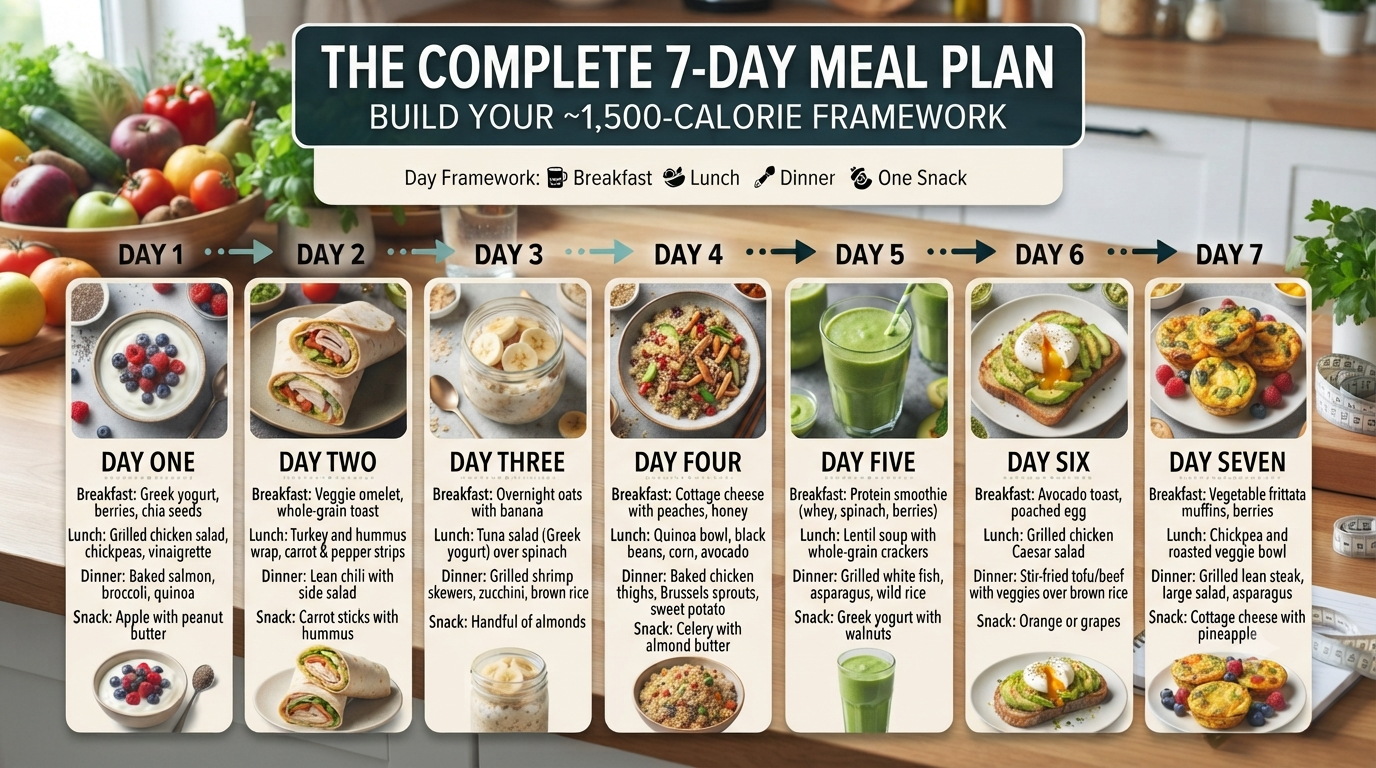
Built around a ~1,500-calorie framework with roughly 100–110g of protein and 28–32g of fiber per day. Scale portions up or down to match the personal target from Step 1. Same structure every day — breakfast, lunch, dinner, one snack — so you’re not relearning a system daily.
Greek yogurt (1 cup, plain, 2% or nonfat) with ½ cup berries and 1 tbsp chia seeds
Grilled chicken breast (4 oz) over mixed greens with chickpeas, cucumber, and olive oil vinaigrette
Baked salmon (4 oz) with roasted broccoli and ½ cup quinoa
Apple with 1 tbsp natural peanut butter
Veggie omelet (2 eggs + 1 egg white, spinach, peppers) with 1 slice whole-grain toast
Turkey and hummus wrap in a whole-wheat tortilla with carrots and bell pepper strips
Lean ground beef or turkey chili (bean-based) with a side salad
Carrot sticks with 2 tbsp hummus
Overnight oats (½ cup rolled oats, unsweetened almond milk, 1 tbsp chia seeds) topped with sliced banana
Tuna salad (Greek yogurt instead of mayo) over a bed of spinach with cherry tomatoes
Grilled shrimp skewers with sautéed zucchini and brown rice
Handful of almonds (about 15)
Cottage cheese (1 cup, low-fat) with sliced peaches and a drizzle of honey
Quinoa bowl with black beans, corn, avocado, and lime dressing
Baked chicken thighs (skinless) with roasted Brussels sprouts and sweet potato
Celery with 1 tbsp almond butter
Protein smoothie (whey or plant protein, spinach, frozen berries, unsweetened almond milk)
Lentil soup with a side of whole-grain crackers
Grilled white fish (cod or tilapia) with asparagus and wild rice
Greek yogurt with a few walnuts
Whole-grain toast with mashed avocado, poached egg, and chili flakes
Grilled chicken Caesar salad, light on the dressing, extra romaine
Stir-fried tofu or lean beef strips with mixed vegetables over brown rice
Orange or a small handful of grapes
Vegetable frittata muffins (make-ahead, 2–3 muffins) with a side of berries
Chickpea and roasted vegetable grain bowl with tahini dressing
Grilled lean steak (4 oz) with a large mixed salad and roasted asparagus
Cottage cheese with pineapple
Log any of these meals against your daily target using our food calorie calculator if you want to confirm you’re hitting your numbers instead of guessing.
Shopping
Sample grocery list for the week
- Eggs
- Greek yogurt
- Cottage cheese
- Chicken breast / thighs
- Salmon
- White fish
- Shrimp
- Lean beef / steak
- Tofu
- Canned tuna
- Whey or plant protein powder
- Rolled oats
- Quinoa
- Brown rice
- Wild rice
- Whole-grain bread
- Whole-wheat tortillas
- Lentils
- Black beans
- Chickpeas
- Spinach
- Mixed greens
- Broccoli
- Zucchini
- Brussels sprouts
- Bell peppers
- Cucumbers
- Cherry tomatoes
- Asparagus
- Carrots
- Celery
- Avocado
- Sweet potatoes
- Bananas
- Berries
- Apples
- Oranges
- Olive oil
- Chia seeds
- Almonds
- Walnuts
- Natural nut butter
- Tahini
- Hummus
Beyond Food
The part most plans leave out
150 minutes a week
The CDC’s physical activity guidelines recommend at least 150 minutes of moderate-intensity activity a week, plus two days of muscle-strengthening work. Strength training tells your body to hold onto muscle while losing fat instead of losing weight indiscriminately. No gym? Try our full-body strength training at home guide.
A glass before each meal
A randomized controlled trial covered by the Center for Science in the Public Interest found adults who drank two cups of water 30 minutes before meals lost about 4 more pounds over 12 weeks than a control group on the same calorie-restricted diet.
Watch For
Common mistakes that derail a 7-day plan
- ✕
Skipping breakfast to “save calories.” This usually backfires into overeating by dinner. Front-loading protein curbs appetite for the rest of the day.
- ✕
Cutting calories too aggressively. Going far below your calculated deficit accelerates muscle loss, not fat loss, and makes Day 8 much harder.
- ✕
Ignoring fiber. Low-fiber, high-protein plans look balanced on paper but leave people hungry by 3pm.
- ✕
Treating Day 7 as the finish line. A 7-day plan is a starting template, not a destination.
- ✕
Not adjusting for your own numbers. Check yours with the diet calculator before you start.
Day 8 and Beyond
What to do after day seven
The habits that make this week work — a calorie target grounded in your own TDEE, adequate protein, enough fiber, some daily movement — are exactly the habits that make month two and month six work as well. The plan doesn’t change; it just repeats with more variety as you get comfortable.
Keep the momentum going
New to structuring longer-term eating? Our step-by-step guide to starting a diet plan picks up exactly where this week leaves off. If your weight has shifted after this first week, check where you land on the BMI calculator and recalculate your TDEE — your calorie target should move as your weight does, roughly every 5–10 pounds.
FAQ
Frequently asked questions
Can I really lose weight in 7 days?
Yes, but manage expectations about what kind. Most people following a genuine deficit for a week see the scale move 2–6 pounds, but a meaningful portion of that early drop is water weight and reduced digestive bulk, not fat. Consistent fat loss follows the CDC’s 1–2 lb/week pace over a longer stretch.
Is 1,500 calories enough for a week?
For many adults, yes — but it depends entirely on your starting TDEE. Someone maintaining at 1,800 calories is in a mild, sustainable deficit at 1,500. Someone maintaining at 2,600 calories is in a much steeper deficit at the same number. Calculate your own number rather than assuming 1,500 applies to you.
Do I need to exercise for this plan to work?
No — the calorie deficit from food alone produces weight loss. But skipping exercise means more of what you lose is likely to be muscle rather than fat. Even 20–30 minutes of walking most days makes a measurable difference.
What if I’m hungry all the time on this plan?
That’s usually a sign your protein or fiber intake is too low relative to your calorie target, not that the deficit itself is wrong. Increase protein and fiber-rich vegetables before you increase total calories.
Can I repeat this exact 7-day plan for a month?
Yes, with variety swapped in every week or two to avoid boredom and cover a wider range of nutrients. The structure — protein, fiber, moderate deficit — is what matters, not the specific dishes.
What to eat for 7 days to lose weight?
Build each day around a lean protein (chicken, fish, eggs, Greek yogurt, tofu), a fiber source (vegetables, legumes, whole grains), and a healthy fat in moderate amounts (olive oil, nuts, avocado) — all sized to fit your personal calorie target. The seven-day plan above follows exactly this structure: a protein-anchored breakfast, a vegetable-heavy lunch, a balanced dinner, and one fiber- or protein-rich snack each day, landing around 1,500 calories, 100–110g protein, and 28–32g fiber daily. What matters more than any single food is hitting a consistent calorie deficit while keeping protein and fiber high enough to control hunger.
How to lose 5kg in 7 days diet?
This isn’t a realistic or safe target. Losing 5kg (about 11 lbs) of actual fat in a week would require a calorie deficit far beyond what the body can sustain without significant muscle loss, nutrient deficiency, and metabolic strain. The CDC and Harvard Health both point to 0.5–1kg (1–2 lbs) a week as the safe, sustainable pace. If the scale drops several kilograms in a single week on a low-carb or very-low-calorie plan, most of that is water weight and glycogen depletion — it returns quickly once normal eating resumes. Aim for a 500–750 calorie daily deficit and treat rapid-loss promises with caution.
How to slim fast in 7 days?
“Fast” and “safe” pull in opposite directions here. What you can genuinely do in seven days is drop visible bloating and water retention by cutting back on refined carbs, added sugar, and excess sodium, drinking water before meals, eating enough fiber, and staying consistent with a moderate calorie deficit and daily movement. That combination — not extreme restriction — is what produces a visibly slimmer, less bloated look by the end of the week, and it’s the only version of “fast” that doesn’t set you up to regain the weight immediately after.
How can I lose 3 kg in one week?
Losing 3kg (about 6.6 lbs) of pure fat in a week isn’t achievable through diet alone without an extreme and unsafe deficit. What is realistic: 1–2 lbs (0.5–1kg) of actual fat loss, plus an additional few pounds of water weight if you’re currently eating a lot of refined carbs and sodium, since each gram of stored glycogen holds roughly 3g of water. Cutting processed carbs, upping fiber and protein, drinking water before meals, and adding daily movement can combine to show a 2–3kg drop on the scale in week one for some people — but most of that isn’t fat, and it isn’t the pace to expect every week going forward.