If you’re counting calories, you’ve probably reached for a can of Diet Dr Pepper instead of the original — but how does it actually hold up once you look past the “zero calorie” label? This guide breaks down the real Diet Dr Pepper nutrition facts, what’s actually in the can, how much caffeine you’re getting, and whether it deserves a spot in a calorie-controlled diet.
Table of Contents
What Is Diet Dr Pepper?
Dr Pepper itself dates back to 1885, when pharmacist Charles Alderton mixed a blend of flavors at Morrison’s Old Corner Drug Store in Waco, Texas — a year before Coca-Cola even existed, according to the Dr Pepper Museum. Diet Dr Pepper arrived decades later as a sugar-free version built around the same signature blend of 23 flavors, using artificial sweeteners instead of high fructose corn syrup to bring the calorie count down to zero.
Today it’s one of the most popular diet sodas in the U.S., often used as a lower-calorie swap for people tracking intake with a daily diet calculator or trying to hit a specific calorie target.
Diet Dr Pepper Nutrition Facts (Per 12 oz Can)
| Nutrient | Amount |
|---|---|
| Calories | 0 |
| Total Fat | 0g |
| Sodium | ~55-60mg |
| Total Carbohydrates | 0g |
| Sugars | 0g |
| Protein | 0g |
| Caffeine | ~41mg |
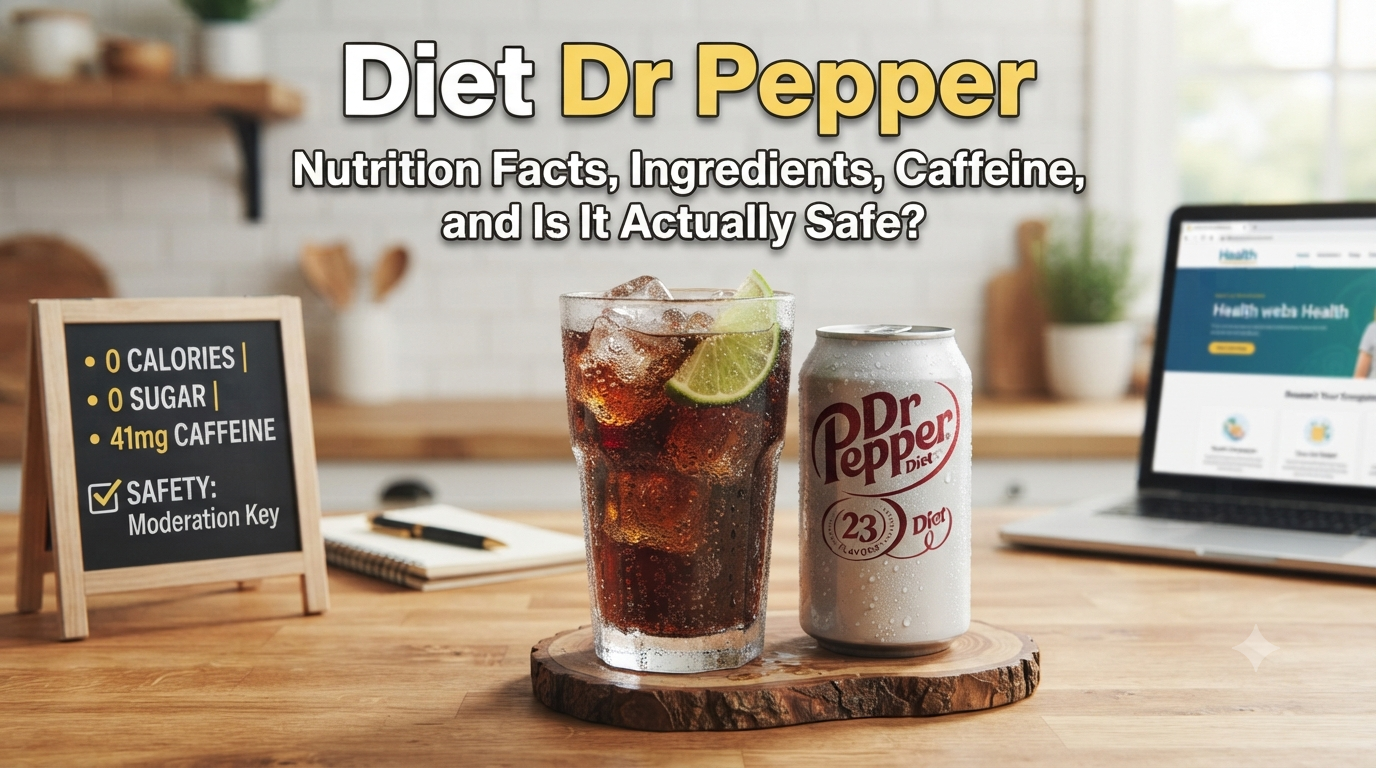
Diet Dr Pepper contains no calories, fat, carbs, sugar, or protein per serving, based on nutrition data compiled by FatSecret. That’s the entire appeal: you get the same 23-flavor taste as regular Dr Pepper without the calorie load.
For comparison, a 12 oz can of regular Dr Pepper carries around 150 calories and roughly 40g of sugar, all from high fructose corn syrup. If you’re trying to figure out where that trade-off actually gets you, plug both options into our free calorie calculator to see how a daily can of regular soda stacks up against your calorie budget over a week.
Diet Dr Pepper Ingredients
The ingredient list is short: carbonated water, caramel color, aspartame, phosphoric acid, natural and artificial flavors, sodium benzoate (as a preservative), and caffeine.
A couple of things worth flagging:
- Aspartame is the primary sweetener, and it’s roughly 200 times sweeter than table sugar, so only a tiny amount is needed to match the sweetness of the sugared version.
- Phosphoric acid gives the drink its tang and acidity — the same additive found in most dark colas.
- Sodium benzoate is a preservative that extends shelf life and prevents mold and bacterial growth in the bottled product.
How Much Caffeine Is in Diet Dr Pepper?
A 12 oz can of Diet Dr Pepper has about 41mg of caffeine, similar to the caffeine content in the regular version. That’s less than half of what you’d get from an 8 oz cup of brewed coffee, but it’s still enough to count toward your daily total if you’re also drinking coffee, tea, or energy drinks.
Is Aspartame in Diet Dr Pepper Safe?
This is the question most people actually want answered, and the honest answer is: it depends on who you ask, and reasonable bodies disagree.
The FDA has reviewed aspartame extensively and maintains that it’s safe for the general population at typical consumption levels, with one exception — people with phenylketonuria (PKU), a rare genetic disorder, cannot metabolize phenylalanine (a component of aspartame) and must avoid it entirely. That’s why you’ll see a PKU warning printed on the can.
In July 2023, the World Health Organization’s cancer research arm (IARC) classified aspartame as “possibly carcinogenic to humans” (Group 2B), a category based on limited evidence rather than strong evidence — the same group that includes things like aloe vera extract and pickled vegetables. In the same announcement, WHO’s separate food additive committee (JECFA) reviewed the same data and left the acceptable daily intake unchanged, concluding the evidence linking aspartame to cancer in humans wasn’t convincing enough to change guidance. At that intake level, an average adult would need to drink well over 9-14 cans of diet soda a day, every day, for a lifetime, before approaching the limit.
The takeaway: occasional or moderate Diet Dr Pepper consumption fits within every major health authority’s current safety guidance, but if you’re a heavy daily soda drinker, it’s reasonable to keep an eye on total artificial sweetener intake across everything you consume, not just one product.
Diet Dr Pepper vs. Regular Dr Pepper: Which Should You Choose?
If your goal is weight loss or maintaining a specific calorie target, Diet Dr Pepper is the clear choice on paper — swapping one daily can of regular Dr Pepper for the diet version saves about 150 calories and 40g of sugar every single day. Over a month, that’s roughly 4,500 calories saved, which is more than a pound of fat.
That said, “zero calories” doesn’t automatically mean “health food.” Diet soda still won’t give you any nutritional value — no vitamins, minerals, fiber, or protein — so it shouldn’t replace water as your primary source of hydration.
Does Diet Dr Pepper Fit Into a Diet Plan?
Yes, for most people, in moderation. Because it contributes zero calories, Diet Dr Pepper doesn’t eat into your daily calorie budget the way regular soda does, which makes it a useful tool if you’re managing a calorie deficit for fat loss. If you haven’t calculated your actual numbers yet, start with our TDEE calculator to find your maintenance calories, then use the calorie deficit calculator to set a realistic daily target.
A few practical tips if you’re a regular diet soda drinker:
- Don’t use it as a hydration substitute. Water should still make up the bulk of your fluid intake.
- Watch total caffeine. If you’re also drinking coffee or energy drinks, the caffeine adds up across the day.
- Track it like any other item. Even at zero calories, logging it in a food calorie calculator keeps your overall tracking habit consistent.
- Pair it with real food goals. If you’re just getting started, our guide on how to start a diet plan walks through building sustainable habits beyond just swapping drinks.
Quick Answers
Diet Dr Pepper FAQ
The straight answers on calories, sweeteners, caffeine, and where it fits in a diet — tap any question to expand it.
No. A standard 12 oz can contains 0 calories, 0g of sugar, and 0g of fat, according to nutrition data from FatSecret.
Aspartame is the primary sweetener used to replicate the sweetness of sugar without adding calories.
Major regulatory bodies, including the FDA, consider aspartame safe for the general population at normal consumption levels. People with PKU should avoid it. Like any soda, it’s best enjoyed in moderation rather than as a daily water replacement.
About 41mg per 12 oz can — less than half the caffeine in a typical cup of brewed coffee.
It can help by removing the ~150 calories and 40g of sugar found in the regular version, which supports a calorie deficit. It isn’t a weight-loss product on its own — overall calorie intake still determines results. Use our daily diet calculator to see how it fits your specific numbers.
Since it contains zero calories, it technically doesn’t break a fast in the caloric sense, though the artificial sweeteners may affect insulin response in some individuals, and opinions among researchers vary on this point.
This article is for general nutrition information only and isn’t a substitute for medical advice. If you have PKU or other dietary concerns, talk to your doctor before consuming products with aspartame. Ready to see exactly where a can of Diet Dr Pepper fits in your day? Try our free daily diet calculator to build your personalized calorie and macro targets