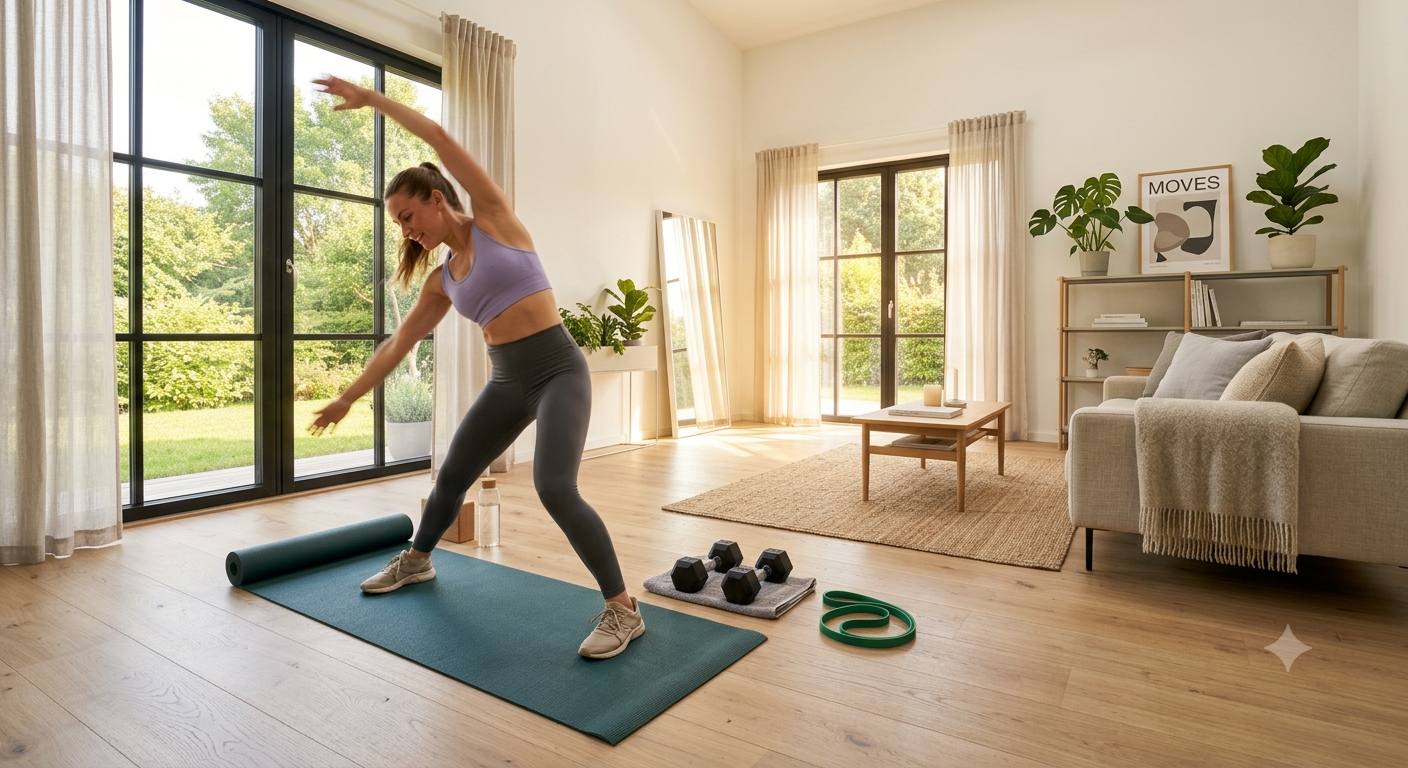
Strength training at home has become one of the most searched fitness topics for a simple reason: it works, and it doesn’t require a gym membership. Whether you’re a complete beginner or someone getting back into a routine, a well-structured home strength workout can build muscle, burn fat, and improve your overall health using nothing more than your bodyweight, a set of dumbbells, or a resistance band.
This guide walks you through everything you need to build a full body strength routine at home — from warmup to cool-down — with exercises organized by equipment type so you can start wherever you are.
Table of Contents
Key Takeaways
- Strength training at home is just as effective as gym-based workouts when done consistently and with proper form.
- You don’t need a full home gym — bodyweight exercises, resistance bands, and a pair of dumbbells are enough to build muscle at home.
- A complete home fitness routine should include a warmup, compound strength exercises, and a cool-down to prevent injury.
- This beginner strength training plan covers bodyweight movements, free weights, and resistance band exercises for a true full-body workout.
- Consistency, progressive overload, and recovery matter more than fancy equipment when it comes to increasing muscle strength.
What are the benefits of strength training?
Resistance training does far more than build visible muscle. Regular strength workouts help:
- Build lean muscle and increase overall muscle strength
- Improve muscle endurance so daily activities feel easier
- Burn body fat and boost metabolism, since muscle tissue burns more calories at rest than fat
- Improve bone density, which becomes increasingly important with age
- Support improved flexibility, posture, and balance
- Enhance functional fitness for everyday movement patterns like lifting, bending, and climbing stairs
- Boost energy levels, support brain health, and improve mood through the release of endorphins
Combined, these benefits make strength training one of the most efficient forms of exercise for long-term health — not just muscle building.
What are the benefits of working out at home?
A home strength training routine removes many of the common barriers that stop people from exercising consistently.
Benefits
- No commute — you save time by skipping the drive to and from the gym
- Flexible scheduling — fit a 20–30 minute strength workout plan into any part of your day
- Lower cost — minimal or no equipment is required to get started
- Privacy and comfort — ideal for beginners who feel intimidated by gym environments
- Scalable difficulty — bodyweight exercises, dumbbells, and resistance bands all allow for progressive difficulty as you get stronger
- Family-friendly — easy to include kids, pets, or a workout partner without needing a facility
Start with a warmup
Every effective home workout should begin with 5–10 minutes of warm-up exercises to raise your heart rate, loosen your joints, and prepare your muscles for resistance work. Try a combination of:
- Arm circles
- Bodyweight squats (slow and controlled)
- Marching or jogging in place
- Hip circles
- Light dynamic stretching for hamstrings and shoulders
A proper warmup reduces injury risk and improves performance during the strength exercises that follow.
Bodyweight strength training exercises
Bodyweight training is the foundation of any home workout without equipment. These movements build strength using nothing but resistance from your own body — perfect for beginners or anyone traveling without access to a home gym.
Lunges
Lunges target the quads, hamstrings, and glutes while also challenging balance and core stability.
- Stand tall with feet hip-width apart.
- Step forward with one leg, lowering your hips until both knees form roughly 90-degree angles.
- Push back to the starting position and repeat on the other side.
- Aim for 10–12 reps per leg.
Squat to overhead raise
This compound movement combines a lower-body squat with an upper-body raise, making it one of the most efficient full-body strength exercises you can do without weights (or with light dumbbells or water bottles for added resistance).
- Stand with feet shoulder-width apart, arms at your sides.
- Lower into a squat, keeping your chest up and knees behind your toes.
- As you stand, raise both arms overhead.
- Lower arms and repeat for 10–15 reps.
Planks
Planks build core strength, stability, and posture — all essential for supporting every other strength exercise in your routine.
- Start in a forearm plank position with elbows under shoulders.
- Keep your body in a straight line from head to heels.
- Engage your core and hold for 20–45 seconds.
- Repeat for 2–3 sets.
Pushups
Pushups are a classic bodyweight exercise for building chest, shoulder, triceps, and core strength.
- Start in a high plank position, hands slightly wider than shoulder-width.
- Lower your chest toward the floor while keeping your body straight.
- Push back up to the starting position.
- Modify on your knees if needed. Aim for 8–12 reps.
Free weight exercises
Adding dumbbells — or household alternatives like water bottles for weights — increases resistance and accelerates muscle building. These free weight exercises target the upper body and complement the bodyweight movements above.
Dumbbell shoulder press
- Stand or sit holding a dumbbell in each hand at shoulder height, palms facing forward.
- Press the weights overhead until arms are fully extended.
- Lower back to shoulder height with control.
- Perform 10–12 reps for 2–3 sets.
Dumbbell triceps kickback
- Hinge forward slightly at the hips with a dumbbell in each hand, elbows bent at 90 degrees.
- Keeping your upper arm still, extend your forearm back until your arm is straight.
- Slowly return to the starting position.
- Complete 10–12 reps per arm.
Resistance band exercises
Resistance bands are an inexpensive, portable option for anyone building a home gym on a budget. A resistance band workout provides continuous tension throughout each movement, which can improve muscle activation compared to free weights alone.
Resistance band pull apart
- Hold the band with both hands at shoulder height, arms extended in front of you.
- Pull the band apart by squeezing your shoulder blades together.
- Return to the start with control.
- Repeat for 12–15 reps to strengthen the upper back and shoulders.
Hip extension
- Anchor the band at a low point or loop it under one foot.
- On hands and knees, loop the band around one foot.
- Extend that leg back and up, squeezing the glute at the top.
- Return and repeat for 12–15 reps per leg.
Resistance band leg press
- Lie on your back with the band looped around one foot, knee bent toward your chest.
- Press the foot forward, extending the leg against the band’s resistance.
- Return with control.
- Complete 12–15 reps per leg.
How to cool down
Cooling down after a strength workout helps your heart rate return to normal and reduces post-workout muscle soreness. Spend 5–10 minutes on:
- Static stretches for the hamstrings, quads, chest, and shoulders
- Deep, controlled breathing
- Light walking in place to gradually lower heart rate
Skipping the cool-down is one of the most common mistakes in a home fitness routine, so don’t rush past this step.
The bottom line
You don’t need a gym membership or a garage full of equipment to see real results. A consistent strength training at home routine — built around bodyweight exercises, free weights, and resistance bands — can help you build muscle, burn fat, and improve strength, balance, and mood over time. Start with two to three sessions per week, focus on proper form over speed, and progressively increase resistance as your strength improves.
Can you do full-body strength training at home?
Bodyweight exercises utilize your own body weight as resistance to build strength, endurance and flexibility. These exercises, such as pushups, squats, lunges and planks, are a great way to build muscle and lose weight, if that’s your goal.
What is the 3 3 3 rule for working out?
The 3-3-3 rule is a highly popular, simplified workout framework. You can interpret it in one of two ways depending on whether you want a weekly schedule or a quick, concentrated gym session
What is a good full-body strength training routine?
A highly effective, time-efficient full body strength routine consists of 6 core compound movements targeting every major muscle group. Perform this workout 3 days a week (e.g., Monday, Wednesday, Friday), doing 3-4 sets of 8-12 repetitions per exercise, resting 60-90 seconds between sets.
What are 5 essential exercises for full-body strength?
The 5 Essential Exercises Everyone Should Do (Plus One Bonus)
Squats — One of the Top Exercises Everyone Should Do for Lower Body Strength. Squats target your glutes, quads, hamstrings, and core. …
Push-Ups — Upper Body Power. …
Rows — Posture Support. …
Planks — Core Stability. …
Walking or Cardio of Choice — Heart Health Matters.