
BMI Calculator
Table of Contents
What Is BMI? A Complete Guide to Body Mass Index
Body Mass Index (BMI) is a screening measure that estimates whether your weight falls within a healthy range for your height. It's one of the most widely used tools in healthcare for a quick, no-cost assessment of weight status — which is why it's built into our BMI calculator above. This guide explains what BMI is, how it's calculated, what the ranges mean, and where it falls short.
What Is BMI, Exactly?
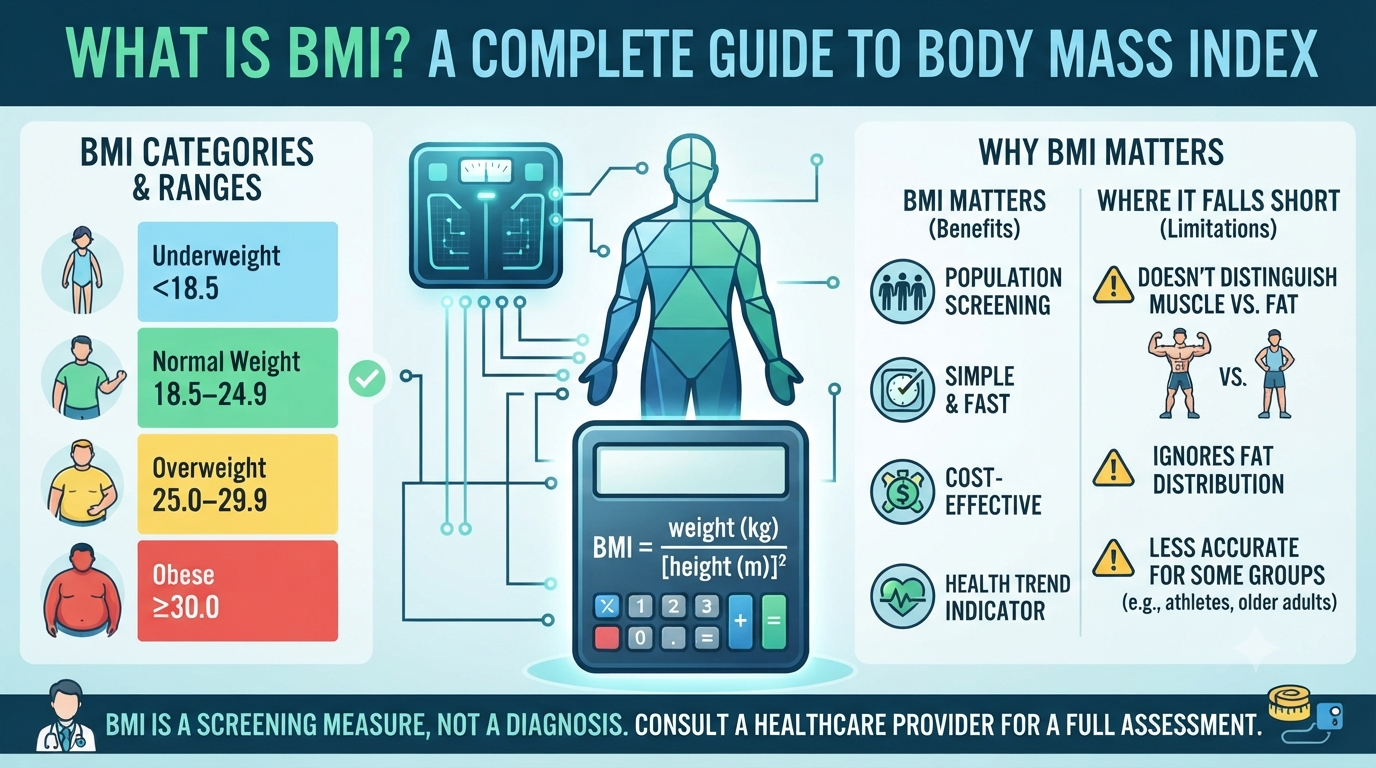
BMI is calculated by dividing your weight in kilograms by the square of your height in meters (kg/m²). In the U.S., it's more commonly worked out from pounds and inches using a conversion factor. The result is a single number that places you into one of four standard weight categories: underweight, normal weight, overweight, or obese.
BMI applies to most adult men and women aged 20 and older. It doesn't require any special equipment beyond a scale and a tape measure, which is part of why it's used so widely by doctors, insurers, and public health agencies as a first-pass screening tool rather than a diagnosis.
How to Calculate BMI
Metric formula: BMI = weight (kg) ÷ [height (m)]²
Imperial formula: BMI = [weight (lb) ÷ height (in)²] × 703
You don't need to do this by hand — you can plug your numbers straight into our BMI calculator at the top of this page, or use our calorie calculator to see how your BMI relates to your daily energy needs.
BMI Categories and Ranges
| BMI Range | Category |
|---|---|
| Below 18.5 | Underweight |
| 18.5 – 24.9 | Normal weight |
| 25.0 – 29.9 | Overweight |
| 30.0 and above | Obese |
These ranges are the standard adult classifications used by both the CDC's Adult BMI Calculator (for adults aged 20 and older) and the WHO, which defines overweight in adults as a BMI of 25 or above, with obesity as a more severe classification.
Why BMI Matters (and Where It Falls Short)
BMI is useful as a population-level screening tool because it's cheap, fast, and correlates reasonably well with body fat for most people. According to the World Health Organization, in 2022 over 2.5 billion adults worldwide were overweight, and of those, 890 million were living with obesity — figures largely tracked using BMI as the standard measure.
That said, BMI has real limitations:
- It doesn't distinguish muscle from fat. A muscular athlete can register as "overweight" despite having low body fat.
- It doesn't account for fat distribution. Where fat is stored (e.g., around the abdomen) matters for health risk, and BMI can't capture that.
- It varies less usefully by age, sex, and ethnicity than some newer body-composition tools.
Because of this, health bodies like the National Heart, Lung, and Blood Institute at the NIH stress that BMI is a screening measure a provider may use to discuss overweight or obesity, but that there is more to overall health than BMI alone.
What to Do With Your BMI Result
If your BMI falls outside the 18.5–24.9 "normal" range, that's not a diagnosis — it's a prompt to look closer. A few practical next steps:
- Check your calorie needs. Use our calorie calculator to see how many calories you need to maintain, gain, or lose weight.
- Look at your macros. Our macro calculator can help you balance protein, carbs, and fat around your goals.
- Talk to a healthcare provider. BMI is a starting point, not the full picture — a doctor can factor in waist circumference, blood work, and family history.
Frequently Asked Questions
Is BMI accurate for everyone? No. It's a reasonable estimate for most adults but less reliable for athletes, older adults, pregnant women, and people with unusually high or low muscle mass.
What's a healthy BMI? For most adults, 18.5–24.9 is considered the normal weight range, per both CDC and NIH guidance.
How often should I check my BMI? There's no fixed schedule — many people check it every few months alongside other measures like waist circumference, rather than obsessively tracking it week to week.
Does BMI apply to children? No. Children and teens are assessed using age- and sex-specific BMI percentiles, not the adult categories shown above. The CDC's Child and Teen BMI Calculator covers that separately.
Sources
- Centers for Disease Control and Prevention – Adult BMI Categories
- Centers for Disease Control and Prevention – About BMI
- World Health Organization – Obesity and Overweight Fact Sheet
- National Heart, Lung, and Blood Institute (NIH) – Overweight and Obesity
- National Heart, Lung, and Blood Institute (NIH) – Aim for a Healthy Weight
This article is for general informational purposes and isn't a substitute for professional medical advice. Talk to a doctor or registered dietitian about what your BMI means for your individual health.